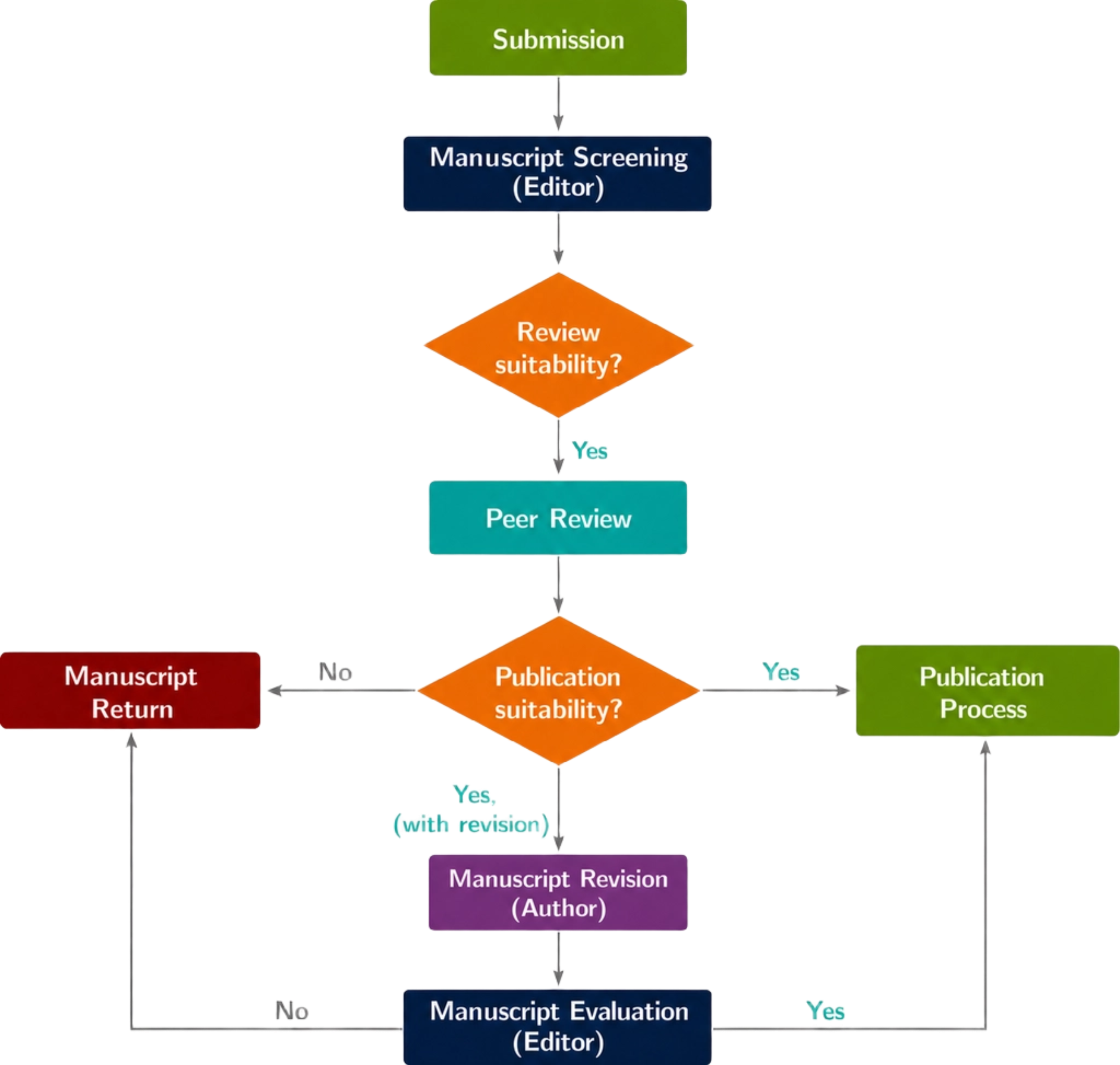
Review and Publication Process

The Asian Educational Therapist operates a double-anonymised peer review process for all submitted manuscripts. Transparency in the review and publication process is a mandatory and a core principle of international scholarly publishing. This page describes every stage of the process from initial submission through to publication, including typical timelines, editorial decision criteria, and the appeals pathway.

All editorial decisions are independent of commercial considerations and are made solely on the basis of scientific quality, scholarly contribution, and compliance with the journal's aims, scope, and publication policies stated on Editorial Independence Policy.

Stage 1 - Submission and Initial Screening

Upon receipt of a manuscript submission, the editorial office performs the following screening before the manuscript proceeds to peer review:
Whether the manuscript makes a genuine scholarly contribution appropriate to the journal's scope and readership
Whether the manuscript's evidential basis meets the journal's requirements
Whether the manuscript is of sufficient quality to merit peer review
Completeness: Manuscript file, Title Page (with author details), documents and all required declarations duly submitted.
Annonymisation: Manuscript file must contain no author names, institutional affiliations, or identifying information. The Title Page is held separately by the editorial office and not shared with reviewers
Plagiarism screening: All manuscripts are screened using iThenticate or equivalent plagiarism detection software. Manuscripts with a similarity index above the acceptable threshold will be returned without review. See the Plagiarism Policy for details.
Ethics compliance: Research involving human participants must include a statement of ethics approval, participant consent, and data confidentiality measures. See the Research Ethics Policy for details
Formatting compliance: Manuscript must comply with the journal's formatting requirements including referencing, word count limits, and the Manuscript Template

The handling editor may request minor pre-review revisions to formatting, scope, or clarity before assigning reviewers. The handling editor may issue a desk rejection for manuscripts that do not meet the journal's evidential standards, are significantly out of scope, or are of clearly insufficient scholarly quality. 


Stage 2 - Double Anonymised Peer Review

Manuscripts approved for peer review are assigned to a minimum of two independent peer reviewers with relevant subject-matter expertise. The selection of reviewers is the responsibility of the handling editor and is conducted in compliance with journal's policies.

i. Reviewer Selection
Reviewers are selected on the basis of subject expertise, publication record, and absence of conflict of interest.
Authors are encouraged to suggest up to three potential reviewers and may request the exclusion of up to two reviewers with reasons. These requests are considered but do not bind the editorial team.
Editorial board members may serve as reviewers for manuscripts outside their area of editorial responsibility, subject to conflict of interest checks.

ii. Review Timeframe
Reviewers are asked to complete and return the Review Form within 21 days of accepting the review invitation. The editorial office monitors review turnaround times and may approach alternative reviewers if the agreed deadline is exceeded without communication.

iii. Review Criteria
Reviewers evaluate manuscripts against the criteria designed to meet the scientific quality requirements for scholarly publishing. They include:
Scientific rigour and methodological soundness
Originality and contribution to the field
Evidential grounding (distinguishing established findings from speculative inference)
Clarity and comprehensibility to an international readership
Ethical compliance and disclosure
Translational and implementation science relevance


Stage 3 - Editorial Decision

Upon receipt of completed Review Forms from all assigned reviewers, the handling editor makes one of the following decisions:

Decision

Outcome and Next Steps

Accept

The manuscript is accepted for publication as submitted. The corresponding author is notified and the manuscript proceeds to Publication Process.

Minor Revision

The manuscript requires minor corrections or clarifications. The corresponding author is sent the Review Forms and asked to submit a revised manuscript and a point-by-point response to reviewers document within 7 days. The revised manuscript is assessed by the handling editor and may not require return to the reviewer(s).

Major Revision

Significant revisions are required. The corresponding author is sent the Review Forms and a deadline of 21 days to submit a substantially revised manuscript with a detailed point-by-point response. The revised manuscript is returned to the original reviewer(s) for re-evaluation. A second major revision cycle is possible but uncommon.

Reject

The manuscript does not meet the journal's standards for publication. The corresponding author receives the Review Forms and a summary of the editorial decision. Authors may appeal this decision. Rejected manuscripts may not be resubmitted to journal unless the handling editor explicitly invites resubmission.

All editorial decisions are communicated to the corresponding author in writing via the journal's portal within 5 business days of the decision being reached.


Stage 4 - Manuscript Revision and Response

Where revision is required, authors must submit both:
A revised manuscript file: with all changes clearly indicated (using track changes or a change summary)
A point-by-point response to reviewers' comments, addressing each reviewer's comments individually, stating what change was made (or providing a reasoned explanation if a suggested change was not adopted)

The response to reviewers' comments is a mandatory component of all revised submissions. It is evaluated by the handling editor and, where applicable, by the original reviewer(s). If an author chooses not to implement a particular suggestion, they should clearly and respectfully justify this decision in the response letter and Review Form.


Stage 5 - Acceptance and Publication

Upon final acceptance, the manuscript enters the copyediting and production process:
Copyediting and language editing are performed by the editorial team to ensure clarity, consistency, and compliance with the journal's style.
Galleys (formatted proofs) are sent to the corresponding author for final approval. Authors must respond within 3 business days. Only typographical corrections are accepted at this stage.
Upon author approval, the article is assigned a DOI and published online in the next available issue.
Metadata (title, abstract, author details, keywords, references) is submitted to indexing databases in compliance with technical requirements.

Typical timeline from final acceptance to online publication: 1 week.


Appeal Process

The journal provides a formal appeals pathway in compliance with COPE guidelines on editorial appeals.

i. Grounds for Appeal
Authors may appeal a rejection decision on the following grounds:
Demonstrable factual error in the review (e.g. a reviewer has significantly misunderstood the methodology or scope of the manuscript)
Demonstrable conflict of interest on the part of a reviewer that was not declared
Evidence that the decision was inconsistent with JAET's stated editorial policies

ii. Grounds NOT Accepted for Appeal
Disagreement with the reviewer's scientific judgement or scholarly opinion
Appeals that simply reiterate the original arguments of the manuscript
Appeals submitted more than 30 days after the rejection decision

iii. How to Appeal
Appeals must be submitted in writing to the Editor-in-Chief via the journal's portal within 30 days of the rejection decision. The appeal must clearly state the grounds for appeal and provide specific evidence in support. The Editor-in-Chief will review the appeal and communicate a final decision within 30 business days. The Editor-in-Chief's decision on appeal is final.

See the Complaints and Appeals Policy.