
Disruptive Behavior Disorders and Juvenile Delinquency: The Dilemma of Disability-Mediated Offending
DOI:
https://doi.org/10.64663/aet.90Keywords:
Disability-Mediated Offending, Disruptive Behavior Disorder, Intervention, Juvenile Delinquency, Juvenile Justice System, Psychoeducational Therapy, RehabilitationAbstract
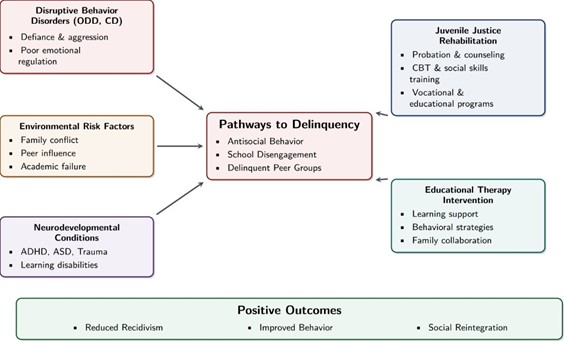
Disruptive Behavior Disorders (DBDs), which include Oppositional Defiant Disorder (ODD) and Conduct Disorder (CD) of either childhood-onset or adolescence-onset or both, are associated with persistent patterns of Childhood and adolescence Aggression, Rule-breaking and Defiance (CAR-D). These behavioral patterns may increase the risk of juvenile delinquency, especially when combined with adverse environmental factors, especially family instability, academic disengagement, and trauma. This article examines the concept of disability-mediated offending (DMO), which suggests that some forms of juvenile offending may be influenced by underlying neurodevelopmental or psychological conditions rather than purely intentional criminal conduct. Drawing on contemporary developmental and criminological literature, the authors explore the pathways linking DBDs to delinquent behavior, the contextual realities of juvenile delinquency in Singapore, and evidence-based rehabilitation approaches. They also highlight the role of educational therapy and interdisciplinary intervention in addressing the developmental and psychosocial needs of at-risk youths. Understanding juvenile offending through both clinical and developmental perspectives may support more balanced responses that combine accountability with rehabilitation and social reintegration.
References
1. Woolfolk, A., & Perry, N. E. (2022). Child and adolescent development (2nd ed.). Hoboken, NJ: Pearson. Available from: https://www.amazon.com/Child-Adolescent-Development-Anita-Woolfolk/dp/0137023111
2. Baglivio, M. T., & Wolff, K. T. (2021). Positive childhood experiences (PCE): Cumulative resiliency in the face of adverse childhood experiences. Youth Violence and Juvenile Justice, 19(2), 139-162. https://doi.org/10.1177/1541204020972487 DOI: https://doi.org/10.1177/1541204020972487
3. Chia, K. H. (2026). From juvenile delinquency (JD) to disability-mediated offending (DMO): A developmental and legal reframing of youth crime. World Journal of Law, 2(1), 12-16. https://doi.org/10.5281/zenodo.18480174
4. Olson, S.L. and Ip, K.I. (2017). Developmental pathways to aggression and violence. In P. Sturmey (Ed.), The Wiley Handbook of Violence and Aggression (pp. 1-12). Hoboken, NJ: John Wiley & Sons. https://doi.org/10.1002/9781119057574.whbva023 DOI: https://doi.org/10.1002/9781119057574.whbva023
5. Milone, A., & Sesso, G. (2022). Disruptive behavior disorders: Symptoms, evaluation and treatment. Brain Sciences, 12(2). Article No. 225. https://doi.org/10.3390/brainsci12020225 DOI: https://doi.org/10.3390/brainsci12020225
6. American Psychiatric Association (2022). Diagnostic and statistical manual of mental disorders (5th ed., text rev.). Washington, DC: American Psychiatric Publishing. https://doi/book/10.1176/appi.books.9780890425787
7. Chia, K. H. (2026b). Disruptive behavior disorders, juvenile delinquency, and disability-mediated offending: A multidisciplinary examination with clinical illustrations. International Journal of Law, Policy, and Social Research, 8(2), 6-9. https://doi.org/10.5281/zenodo.19416522
8. Snyder, H. (2019). Literature review as a research methodology: An overview and guidelines. Journal of Business Research, 104, 333-339. https://doi.org/10.1016/j.jbusres.2019.07.039 DOI: https://doi.org/10.1016/j.jbusres.2019.07.039
9. Webster, J., & Watson, R. T. (2002). Analyzing the past to prepare for the future: Writing a literature review. MIS quarterly, 26(2), xiii-xxiii. Available from: https://www.jstor.org/stable/4132319 DOI: https://doi.org/10.2307/4132319
10. Reichert, R. A., Andrade, F. R. T., Reichert, N. C. M., Fidalgo, T. M., De Micheli, D., da Silveira, D. X. (2025). Disruptive, impulse control and conduct disorders. In R. A. Reichert, A. L. M. Andrade, & D. De Micheli (eds), Neuropsychology and substance use disorders (pp. 475-505). Cham, Switzerland: Springer. https://doi.org/10.1007/978-3-031-82614-6_23 DOI: https://doi.org/10.1007/978-3-031-82614-6_23
11. Frick, P. J., & Ray, J. V. (2015). Evaluating callous‐unemotional traits as a personality construct. Journal of Personality, 83(6), 710-722. https://doi.org/10.1111/jopy.12114 DOI: https://doi.org/10.1111/jopy.12114
12. Xie, Q., Bi, T., Luo, W., Li, X., Yang, B., & Kou, H. (2024). The prevalence and risk factors of conduct disorder among juvenile delinquents in China. Humanities and Social Sciences Communications, 11. Article No. 278. https://doi.org/10.1057/s41599-024-02775-2 DOI: https://doi.org/10.1057/s41599-024-02775-2
13. Del Toro, J., Jackson, D. B., Testa, A., & Wang, M.-T. (2023). The spillover effects of classmates’ police intrusion on adolescents’ school-based defiant behaviors: The mediating role of institutional trust. American Psychologist, 78(8), 941-954. https://doi.org/10.1037/amp0001148 DOI: https://doi.org/10.1037/amp0001148
14. Moffitt, T. E. (2018). Male antisocial behavior in adolescence and beyond. Nature Human Behavior, 2, 177-186. https://doi.org/10.1038/s41562-018-0309-4 DOI: https://doi.org/10.1038/s41562-018-0309-4
15. Cinini, S. F, & Mkhize, S. M. (2023). Criminal behavior and youth crime: A juvenile delinquency perspective on adverse childhood experience. In S. Güney (Ed.), Criminal behavior: The underlyings, and Contemporary Applications (pp. 1-15). London, UK: IntechOpen. https://doi.org/10.5772/intechopen.1001888 DOI: https://doi.org/10.5772/intechopen.1001888
16. Basto-Pereira, M., Farrington, D.P. & Maciel, L. (2024). Unraveling the sequences of risk factors underlying the development of criminal behavior. Journal of Developmental and Life-Course Criminology, 10, 242-264. https://doi.org/10.1007/s40865-024-00254-5 DOI: https://doi.org/10.1007/s40865-024-00254-5
17. Fazel, S., Doll, H., & Långström, N. (2008). Mental disorders among adolescents in juvenile detention and correctional facilities: a systematic review and metaregression analysis of 25 surveys. Journal of the American Academy of Child & Adolescent Psychiatry, 47(9), 1010-1019. https://doi.org/10.1097/CHI.ObO13e31817eecf3 DOI: https://doi.org/10.1097/CHI.ObO13e31817eecf3
18. Loeber, R., & Burke, J. D. (2011). Developmental pathways in juvenile externalizing and internalizing problems. Journal of Research on Adolescence, 21(1), 34-46. https://doi.org/10.1111/j.1532-7795.2010.00713.x DOI: https://doi.org/10.1111/j.1532-7795.2010.00713.x
19. Ilahy, A. D., Kaaffah, M. S., Latipah, E., Har, A. A. A., & Bestari, D. (2025). Developmental psychology of learners: Environmental factors influencing child development. Linguanusa: Social Humanities, Education and Linguistic, 3(2), 98-114. https://doi.org/10.63605/ln.v3i2.92 DOI: https://doi.org/10.63605/ln.v3i2.92
20. Andrews, D. A., & Bonta, J. (2016). The psychology of criminal conduct (6th ed.). New York, NY: Routledge. https://doi.org/10.4324/9781315677187 DOI: https://doi.org/10.4324/9781315677187
21. Lipsey, M. W., Howell, J. C., Kelly, M. R., Chapman, G., & Carver, D. (2020). Improving the effectiveness of juvenile justice programs: A new perspective on evidence-based practice. NCJ Number: 233424. Washington, CD: Center for Juvenile Justice Reform, Georgetown University. Available from: https://www.ojp.gov/ncjrs/virtual-library/abstracts/improving-effectiveness-juvenile-justice-programs-new-perspective
22. Singapore Statutes Online (2026). Children and Young Persons Act 1993 (2020 Rev. Ed., informal consolidation, version in force from 30 December 2025). Singapore: Attorney-General's Chambers of Singapore. Available from: https://sso.agc.gov.sg/Act/CYPA1993
23. Ministry of Social and Family Development (2024a). Supporting youth rehabilitation trend report November 2024. Singapore: The Author. Available form: https://www.msf.gov.sg/docs/default-source/research-data/supporting_youth_rehabilitation_trends_report_2024.pdf?sfvrsn=af6cde56_3
24. National Committee on Prevention, Rehabilitation and Recidivism (NCPR) (2021). Overview of the National Committee on Prevention, Rehabilitation and Recidivism (NCPR) [Presentation slides]. Available from: https://www.msf.gov.sg/docs/default-source/msf-event/ncpr-cygo-overview-of-ncpr.pdf?sfvrsn=aee0fb5a_3
25. Nathen, C., Singh, M., & Ruby, K. (2024). Singapore's multi-pronged approach in the rehabilitation of persons who have offended. In M. C. Chu & M. Daffern (Eds.), Approaches to offender rehabilitation in Asian jurisdictions (pp. 163-178). New York, NY: Routledge. https://doi.org/10.4324/9781003360919 DOI: https://doi.org/10.4324/9781003360919-13
26. Ministry of Social and Family Development (n.d.). Factsheet on youth delinquency. Available from: https://www.msf.gov.sg/docs/default-source/ncpr/factsheet-on-youth-delinquency2fa97cee-baa3-401c-a986-71eb8871bb0b.pdf?sfvrsn=f3f45658_5
27. Ministry of Social and Family Development (2024b). Recidivism rates. In Supporting Youth Rehabilitation Trend Report November 2024 [Dataset]. data.gov.sg. Retrieved April 8, 2026 from https://data.gov.sg/datasets/d_9af2a750c50bcfe8ae5f99b3022ac22d/view
28. Neo, D., Lee, J. H., Chew, M. X. H., Sarfoji, M., & Prakash, T. (2021). Community-based rehabilitation's effectiveness in reducing Singapore juvenile recidivism. Scholarly Commons: Introduction to Research Methods RSCH 202. Available form: https://commons.erau.edu/ww-research-methods-rsch202/24/
29. Singapore Courts (2024 [Upated: 2026, March 13]). Family justice courts practice directions 2024: Youth courts. Available from: https://epd2024-familyjusticecourts.judiciary.gov.sg/part-26-youth-courts
30. Dattagupta, J., Banerjee, A., Maji, B. & Chattopadhyay, P. (2024). A multifaceted approach to identifying and managing juvenile delinquency by integrating psycho-physiological indicators. International Journal of Adolescent Medicine and Health, 36(4), 321-333. https://doi.org/10.1515/ijamh-2024-0052 DOI: https://doi.org/10.1515/ijamh-2024-0052
31. Kim, Y.-J., & Kwon, R.-H. (2023). A study on the operational model for individualized rehabilitation planning (IRP) through the linkage between supported employment and customized employment based on lifelong education for persons with developmental disabilities. The Research Institute for Special Education & Rehabilitation Science, 62(2), 185-234. Available from: https://www.dbpia.co.kr/Journal/articleDetail?nodeId=NODE11589782 DOI: https://doi.org/10.23944/Jsers.2023.06.62.2.8
32. Singapore Courts. (2026, March 13). Media release: Launch of the youth courts therapeutic justice model. https://www.judiciary.gov.sg/news-and-resources/news/news-details/media-release-launch-of-the-youth-courts-therapeutic-justice-model
33. Ding, Z. (2025). A Holistic Educational Therapy Approach for Autism and Comorbid Emotional-Behavioral Disorders. The Asian Educational Therapist, 3(3), 3-16. https://doi.org/10.64663/aet.7 DOI: https://doi.org/10.64663/aet.7
34. McCart, M. R., Sheidow, A. J., & Jaramillo, J. (2023). Evidence Base Update of Psychosocial Treatments for Adolescents with Disruptive Behavior. Journal of Clinical Child & Adolescent Psychology, 52(4), 447-474. https://doi.org/10.1080/15374416.2022.2145566 DOI: https://doi.org/10.1080/15374416.2022.2145566
35. Park, J. S., & Yoo, J. H. (2026). Evidence-Based Psychotherapy for Disruptive Behavior Disorders. Journal of the Korean Academy of Child and Adolescent Psychiatry, 37(1), 22-32. https://doi.org/10.5765/jkacap.250060 DOI: https://doi.org/10.5765/jkacap.250060
36. Chia, K. H. (2024). A short review of psychoeducational therapy (PsyEdTx). The Asian Educational Therapist, 2(1), 3–11. https://doi.org/10.64663/aet.27 DOI: https://doi.org/10.64663/aet.27
37. Saleh, Z., Abdullah, S. M. S., Ling, K. G., & Ab Rahman, S. N. (2025). Identifying the psycho-educational strategies in dealing with aggressive behavior from the counselor's perspective. Environment-Behavior Proceedings Journal, 10(SI24), 191-196. https://doi.org/10.21834/e-bpj.v10iSI24.6386 DOI: https://doi.org/10.21834/e-bpj.v10iSI24.6386
38. Hassani, S., & Schwab, S. (2021). Social-emotional learning interventions for students with special educational needs: A systematic literature review. Frontiers on Education, 6. Article ID: 808566. https://doi.org/10.3389/feduc.2021.808566 DOI: https://doi.org/10.3389/feduc.2021.808566
39. Perez, B. R., & Bahamon Muneton, M. J. (2023). The socio-emotional dimension in education: A systematic review. Issues in Educational Research, 33(1), 307-326. https://search.informit.org/doi/10.3316/informit.173573406487575
40. Trpevska, E.M., Lažetić, G. (2023). Restorative vs punitive approach. Eight fundamental principles of juvenile delinquency prevention. In: Czarnecki, l. (ed.) Human Rights Protection and Ius Puniendi. European Union and its Neighbours in a Globalized World, vol 11. Springer. https://doi.org/10.1007/978-3-031-41253-0_5 DOI: https://doi.org/10.1007/978-3-031-41253-0_5
41. Thorpe, D. H., Smith, D., Green, C. J., & Paley, J. H. (2024). Out of care: The community support of juvenile offenders. London, UK: Routledge. https://doi.org/10.4324/9781003501831 DOI: https://doi.org/10.4324/9781003501831
42. Trifan, M. (2015). Adolescence, violence and psychoeducation. In L.-I. Vîșcu, I.-E. Cădariu, D. Rad, & C. E. Watkins Jr. (Eds.). Psychoeducational challenges in the 21st century (pp. 185-193). Cluj-Napoca, Romania: Presa Universitară Clujeană. https://editura.ubbcluj.ro/index.php/puc/catalog/download/3578/24342/6143?inline=1
43. Chua, J. R., Chu, C. M., Yim, G., Chong, D., & Teoh, J. (2014). Implementation of the risk-need-responsivity framework across the juvenile justice agencies in Singapore. Psychiatry, Psychology, and Law: An Interdisciplinary Journal of the Australian and New Zealand Association of Psychiatry, Psychology and Law, 21(6), 877-889. https://doi.org/10.1080/13218719.2014.918076 DOI: https://doi.org/10.1080/13218719.2014.918076
44. Dishion, T. J., & Tipsord, J. M. (2011). Peer contagion in child and adolescent social and emotional development. Annual Review of Psychology, 62, 189-214. https://doi.org/10.1146/annurev.psych.093008.100412 DOI: https://doi.org/10.1146/annurev.psych.093008.100412
Published
How to Cite
Issue
Section
License
Copyright (c) 2026 Harjit SINGH, Kok Hwee CHIA

This work is licensed under a Creative Commons Attribution 4.0 International License.