Autism Spectrum Disorder: From Diagnosis to Public and Family Resource Constraints - A Narrative Review
DOI:
https://doi.org/10.64663/aet.107Keywords:
autism spectrum disorder, educational therapy, family caregiving, functional assessment, inclusive education, service access supportAbstract
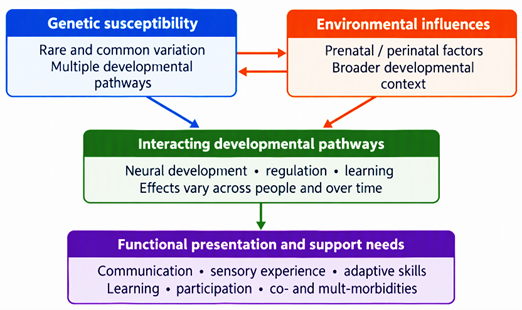
Autism spectrum disorder is a heterogeneous neurodevelopmental condition whose management requires more than diagnostic classification. This narrative review examines clinical features, genetic and environmental influences, diagnosis, educational-therapy evaluation, co- and multi-morbidities, public and family resource constraints. Major period of literature review coverage is from January 2017 until August 2026, with some important exceptions from the past. Complexity of intervention takes into account the interaction of communication, sensory, cognitive, adaptive and health requirements and not the number of subtypes that are known. Psychiatric diagnosis and educational evaluation provide complementary evidence. Cognitive profiling informs learning support but does not independently diagnose autism. Cognition-Conation-Affect-Sensation and Hierarchy of Abilities and Skills are considered alongside Cattell-Horn-Carroll theory. Country examples from Israel, mainland China and Singapore illustrate demand, household costs and inclusion challenges. An explicitly conceptual supply and demand for support model compares domain-specific needs with sustainable family capacity and accessible public provision. Sustainable support requires coordinated assessment, proportionate intervention, accommodations, caregiver protection and transparent review, with outcomes judged by participation, safety and wellbeing.
References
1. American Psychiatric Association. Diagnostic and statistical manual of mental disorders: DSM-5-TR. 5th ed., text rev. Washington, DC: American Psychiatric Association; 2022. https://doi.org/10.1176/appi.books.9780890425787 DOI: https://doi.org/10.1176/appi.books.9780890425787
2. Lord C, Charman T, Havdahl A, Carbone P, Anagnostou E, Boyd B, et al. The Lancet Commission on the future of care and clinical research in autism. Lancet. 2022;399(10321):271–334. https://doi.org/10.1016/S0140-6736(21)01541-5 DOI: https://doi.org/10.1016/S0140-6736(21)01541-5
3. World Health Organization. International Classification of Diseases, 11th Revision (ICD-11): 6A02 Autism spectrum disorder [Internet]. Geneva: World Health Organization; 2019 [cited 2026 Nov 23]. Available from: https://icd.who.int/
4. Dinstein I, Solomon S, Zats M, Shusel R, Lottner R, Ben Gershon B, et al. Large increase in ASD prevalence in Israel between 2017 and 2021. Autism Res. 2024;17(2):410–8. https://doi.org/10.1002/aur.3085 DOI: https://doi.org/10.1002/aur.3085
5. Zhao Y, Luo Y, Zhang R, Zheng X. Direct and indirect costs for families of children with autism spectrum disorder in China. Autism. 2023;27(8):2337–47. https://doi.org/10.1177/13623613231158862 DOI: https://doi.org/10.1177/13623613231158862
6. Poljac E, Bekkering H. A review of intentional and cognitive control in autism. Front Psychol. 2012;3:436. https://doi.org/10.3389/fpsyg.2012.00436 DOI: https://doi.org/10.3389/fpsyg.2012.00436
7. Ji Y, Zhu FL, Yin PP, Zeng ST, Huang Z. Sensory processing atypicalities and social responsiveness in autism spectrum disorder: the mediation of executive function. Front Psychiatry. 2025;16:1696983. https://doi.org/10.3389/fpsyt.2025.1696983 DOI: https://doi.org/10.3389/fpsyt.2025.1696983
8. Patil O, Kaple M. Sensory processing differences in individuals with autism spectrum disorder: a narrative review of underlying mechanisms and sensory-based interventions. Cureus. 2023;15(10):e48020. https://doi.org/10.7759/cureus.48020 DOI: https://doi.org/10.7759/cureus.48020
9. Singh H, Chia KH. Intellectual and developmental disabilities: definitions, diagnostic limitations, and cross-system classification. World J Res Educ. 2026;2(1):1–6. Available from: https://www.educationworldjournal.com/assets/archives/2026/vol2issue1/2001.pdf
10. Chia K.H., Tan M.K., Jia X. From the Hierarchy of Abilities and Skills (HAS) to an Integrated Pediatric and Educational Therapies (IPET) framework: a conceptual model for assessment and intervention. Asian J Pediatr Res. 2026;16(3). https://doi.org/10.9734/ajpr/2026/v16i3535 DOI: https://doi.org/10.9734/ajpr/2026/v16i3535
11. Chua CK. Cognitive profiling in autism spectrum disorder: what the Cattell–Horn–Carroll theory reveals. Asian Educ Ther. 2026;4(2):74–84. https://doi.org/10.64663/aet.87 DOI: https://doi.org/10.64663/aet.87
12. Baethge C, Goldbeck-Wood S, Mertens S. SANRA—a scale for the quality assessment of narrative review articles. Res Integr Peer Rev. 2019;4:5. https://doi.org/10.1186/s41073-019-0064-8 DOI: https://doi.org/10.1186/s41073-019-0064-8
13. National Institute for Health and Care Excellence. Autism spectrum disorder in under 19s: recognition, referral and diagnosis. Clinical guideline CG128. London: National Institute for Health and Care Excellence; 2011 (amended 2017). Available from: https://www.nice.org.uk/guidance/cg128
14. Rossignol DA, Frye RE. Early biomarker for autism spectrum disorder unveiled—what are we learning? Expert Rev Mol Diagn. 2025;25(8):413–8. https://doi.org/10.1080/14737159.2025.2518143 DOI: https://doi.org/10.1080/14737159.2025.2518143
15. Dean M, Harwood R, Kasari C. The art of camouflage: gender differences in the social behaviors of girls and boys with autism spectrum disorder. Autism. 2017;21(6):678–89. https://doi.org/10.1177/1362361316671845 DOI: https://doi.org/10.1177/1362361316671845
16. Litman A, Sauerwald N, Green Snyder L, Foss-Feig J, Park CY, Hao Y, et al. Decomposition of phenotypic heterogeneity in autism reveals underlying genetic programs. Nat Genet. 2025;57(7):1611–9. https://doi.org/10.1038/s41588-025-02224-z DOI: https://doi.org/10.1038/s41588-025-02224-z
17. Cross-Disorder Group of the Psychiatric Genomics Consortium. Genomic relationships, novel loci, and pleiotropic mechanisms across eight psychiatric disorders. Cell. 2019;179(7):1469–1482.e11. https://doi.org/10.1016/j.cell.2019.11.020 DOI: https://doi.org/10.1016/j.cell.2019.11.020
18. Masi A, DeMayo MM, Glozier N, Guastella AJ. An overview of autism spectrum disorder, heterogeneity and treatment options. Neurosci Bull. 2017;33(2):183–93. https://doi.org/10.1007/s12264-017-0100-y DOI: https://doi.org/10.1007/s12264-017-0100-y
19. Kentrou V, de Veld DM, Mataw KJ, Begeer S. Delayed autism spectrum disorder recognition in children and adolescents previously diagnosed with attention-deficit/hyperactivity disorder. Autism. 2019;23(4):1065–72. https://doi.org/10.1177/1362361318785171 DOI: https://doi.org/10.1177/1362361318785171
20. Bargiela S, Steward R, Mandy W. The experiences of late-diagnosed women with autism spectrum conditions: an investigation of the female autism phenotype. J Autism Dev Disord. 2016;46(10):3281–94. https://doi.org/10.1007/s10803-016-2872-8 DOI: https://doi.org/10.1007/s10803-016-2872-8
21. Association of Educational Therapists. Educational therapy fact sheet [Internet]. https://cdn.ymaws.com/aetonline.org/resource/resmgr/about_section/governance_docs/et_fact_sheet.pdf
22. Mayes SD, Calhoun SL. WISC-IV and WIAT-II profiles in children with high-functioning autism. J Autism Dev Disord. 2008;38(3):428–39. https://doi.org/10.1007/s10803-007-0410-4 DOI: https://doi.org/10.1007/s10803-007-0410-4
23. Moody CT, Laugeson EA. Social skills training in autism spectrum disorder across the lifespan. Child Adolesc Psychiatr Clin N Am. 2020;29(2):359–71. https://doi.org/10.1016/j.chc.2019.11.001 DOI: https://doi.org/10.1016/j.chc.2019.11.001
24. Ferman S, Segal O. The face of autism in Israel. Neuropsychiatr Dis Treat. 2024;20:1677–92. https://doi.org/10.2147/NDT.S466420 DOI: https://doi.org/10.2147/NDT.S466420
25. Han E, Tan MMJ, Crane L, Legido-Quigley H. A qualitative study of autism services and supports in Singapore: perspectives of service providers, autistic adults and caregivers. Autism. 2021;25(8):2279–90. https://doi.org/10.1177/13623613211016112 DOI: https://doi.org/10.1177/13623613211016112
26. Kakooza-Mwesige A, Bakare M, Gaddour N, Juneja M. The need to improve autism services in lower-resource settings. Lancet. 2022;399(10321):217–20. https://doi.org/10.1016/S0140-6736(21)02658-1 DOI: https://doi.org/10.1016/S0140-6736(21)02658-1
27. National Institute for Health and Care Excellence. Autism spectrum disorder in under 19s: support and management. Clinical guideline CG170. London: National Institute for Health and Care Excellence; 2013. Available from: https://www.nice.org.uk/guidance/cg170
28. Tinelli M, Roddy A, Knapp M, Arango C, Mendez MA, Cusack J, et al. Economic analysis of early intervention for autistic children: findings from four case studies in England, Ireland, Italy, and Spain. Eur Psychiatry. 2023;66(1):e76. https://doi.org/10.1192/j.eurpsy.2023.2449 DOI: https://doi.org/10.1192/j.eurpsy.2023.2449
Downloads
Published
Issue
Section
License
Copyright (c) 2026 Chua Chin TEO

This work is licensed under a Creative Commons Attribution 4.0 International License.