
How to identify a Talented Musician in Children with Autism
DOI:
https://doi.org/10.64663/aet.57Keywords:
Musical Traits, Musical systemizing abilityAbstract
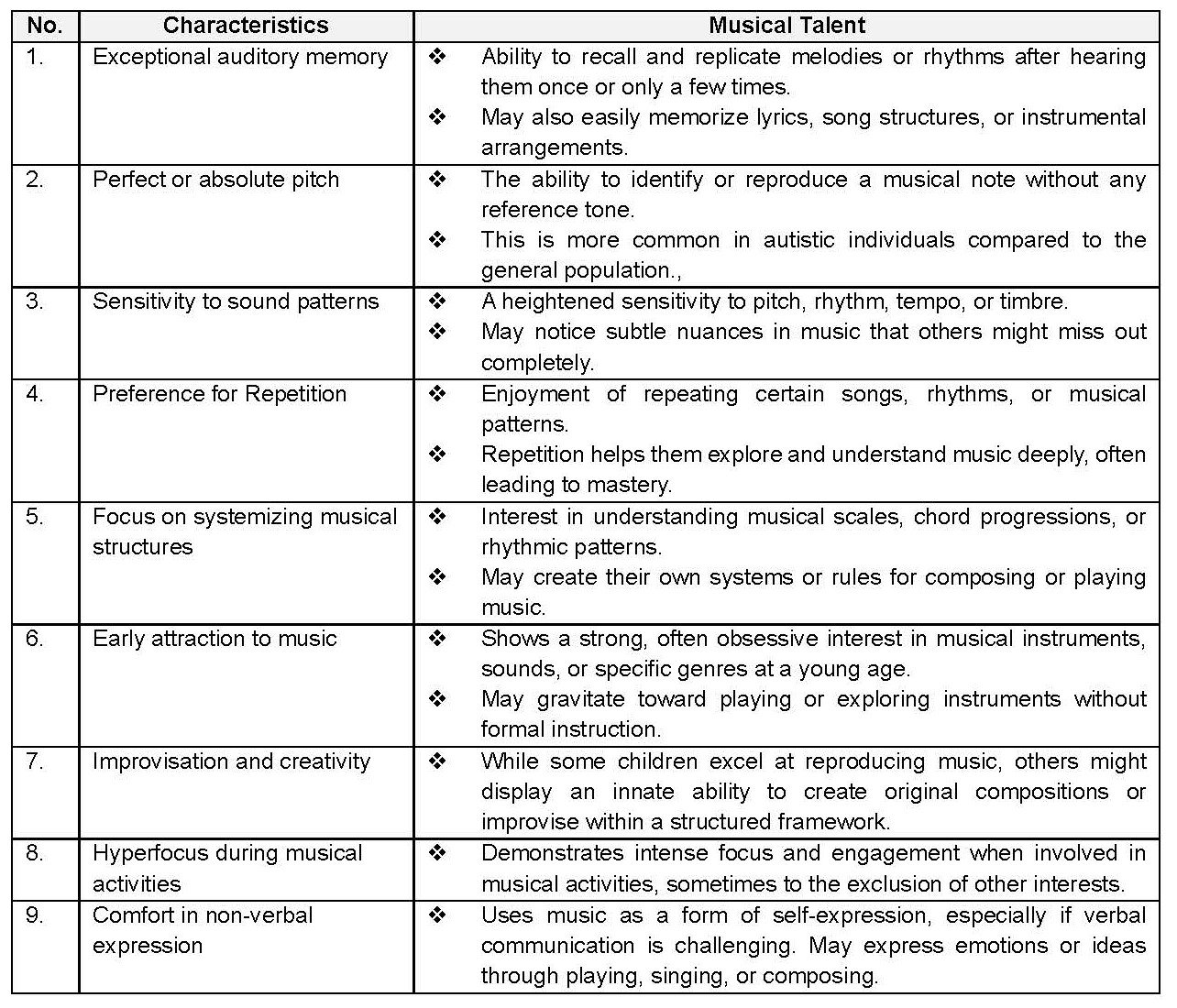
Many parents whom I have met in my course of work often ask me this question: “Can my child with autism become a talented musician?” There is no direct answer to that question (also see Howlin et al., 2009). To the best of my knowledge, autistic musicians often possess unique and extraordinary talents, often excelling in areas such as perfect pitch, composing, or creating innovative musical styles (Pring, 2005). Just like the autistic savant artists (Camulli & Goh, 2018), autistic savant musicians also do possess extraordinary systemizing ability, but in the creative domain of music (Treffert, 2010). Their attention to detail and ability to focus intensely on their craft can result in exceptional music. One good example is Jacob Collier, who is a Grammy-winning multi-instrumentalist, composer, and arranger. is open about being autistic. Similarly, in another example, Tony DeBlois, a blind and autistic musician, plays over 20 instruments and has performed worldwide.
References
Camulli, J. E., & Goh, L. A. L. (2018). Re-conceptualising autistic savantism as a spectrum syndromic disorder: a sequel to the case study of a young adult savant artist. European Journal of Special Education Research., 3(4), 185-204. http://dx.doi.org/10.46827/ejse.v0i0.1919.
Chung, S., & Son, J. W. (2023). How well do we understand autistic savant artists: A review of various hypotheses and research findings to date. Journal of the Korean Academy of Child and Adolescent Psychiatry, 34(2), 93-111. https://doi.org/10.5765/jkacap.230004 DOI: https://doi.org/10.5765/jkacap.230004
Happé, F., & Frith, U. (2009). The beautiful otherness of the autistic mind. Philosophical Transactions of the Royal Society B: Biological Sciences, 364(1522), 1345-1350. https://doi.org/10.1098/rstb.2009.0009 DOI: https://doi.org/10.1098/rstb.2009.0009
Heaton, P., Hermelin, B., & Pring, L. (1998). Autism and pitch processing: A precursor for savant musical ability?. Music Perception, 15(3), 291-305. https://doi.org/10.2307/40285769 DOI: https://doi.org/10.2307/40285769
Howlin, P., Goode, S., Hutton, J., & Rutter, M. (2009). Savant skills in autism: psychometric approaches and parental reports. Philosophical Transactions of the Royal Society B: Biological Sciences, 364(1522), 1359-1367. https://doi.org/10.1098/rstb.2008.0328 DOI: https://doi.org/10.1098/rstb.2008.0328
Hughes, J. E., Ward, J., Gruffydd, E., Baron-Cohen, S., Smith, P., Allison, C., & Simner, J. (2018). Savant syndrome has a distinct psychological profile in autism. Molecular Autism, 9, 1-18. https://doi.org/10.1186/s13229-018-0237-1 DOI: https://doi.org/10.1186/s13229-018-0237-1
Pring, L. (2005). Savant talent. Developmental medicine and child neurology, 47(7), 500-503. https://doi.org/10.1111/j.1469-8749.2005.tb01180.x DOI: https://doi.org/10.1017/S0012162205000976
Treffert, D. A. (2010). Islands of genius: The bountiful mind of the autistic, acquired, and sudden savant. Philadelphia, PA: Jessica Kingsley Publishers.
van der Zee, E., & Derksen, J. J. (2021). The power of systemizing in autism. Child Psychiatry & Human Development, 52(2), 321-331. https://doi.org/10.1007/s10578-020-01014-4 DOI: https://doi.org/10.1007/s10578-020-01014-4
Young, R. L., & Nettelbeck, T. (1995). The abilities of a musical savant and his family. Journal of autism and developmental disorders, 25(3), 231-248. https://doi.org/10.1007/BF02179286 DOI: https://doi.org/10.1007/BF02179286
Downloads
Published
How to Cite
Issue
Section
License
Copyright (c) 2025 The Asian Educational Therapist

This work is licensed under a Creative Commons Attribution 4.0 International License.