A General Review on Sexual Awareness in Children and Adolescents with Special Needs
DOI:
https://doi.org/10.64663/aet.38Keywords:
Developmental phases, Sexual Awareness, Sexuality, Sexuality Awareness, Special needsAbstract
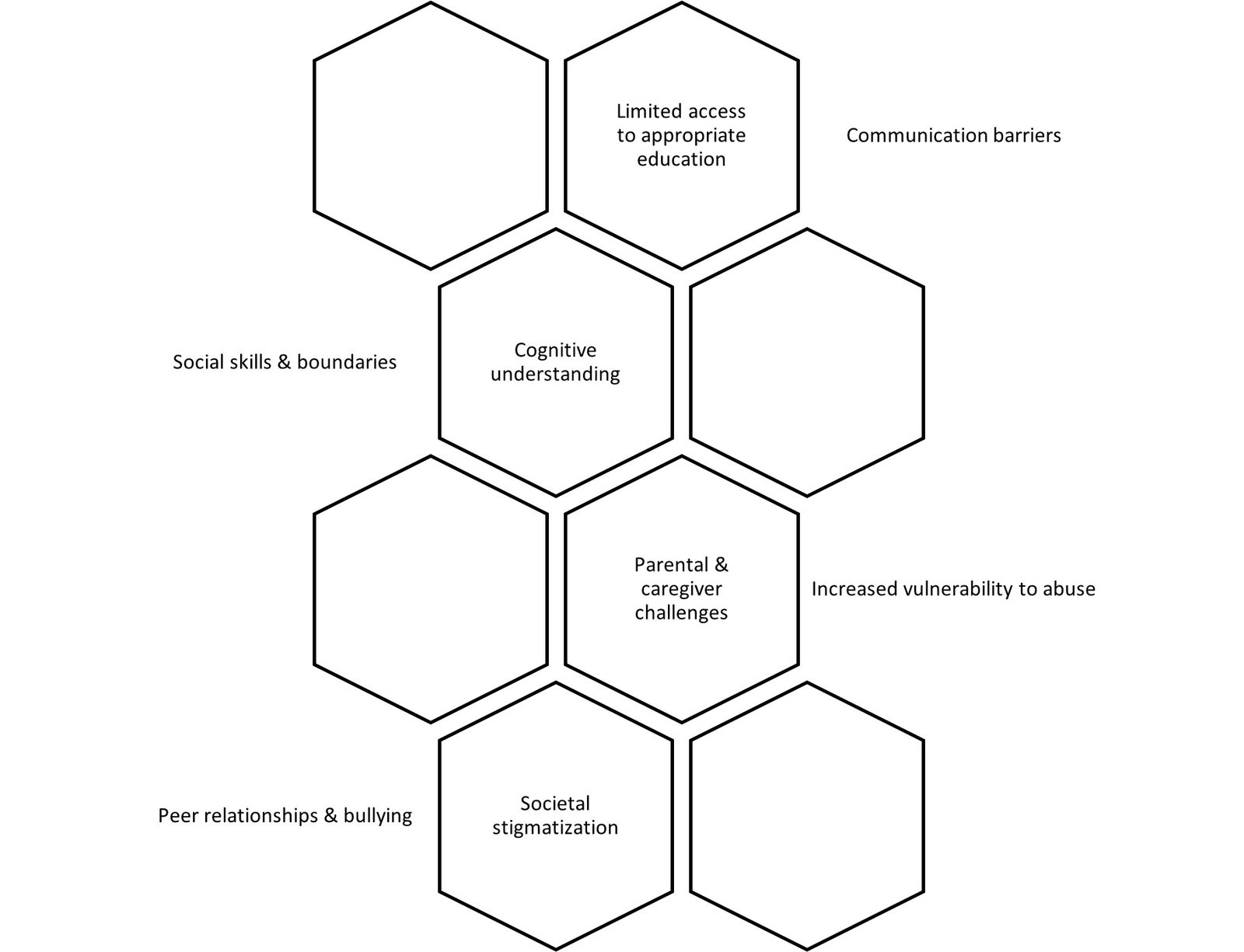
Sexual awareness in children and adolescents with special needs is a critical yet often overlooked aspect of their development. This paper explores the concept of sexual awareness, delineating it from sexuality and/or sexuality awareness. While sexuality encompasses a broad range of physical, emotional, and social aspects related to sex, sexual awareness pertains to recognizing one’s own and others’ sexual feelings and behaviors. Sexuality awareness extends this understanding to include societal norms and personal values about sexuality. The developmental trajectory of sexual awareness is outlined from birth through late adolescence, emphasizing unique milestones and challenges faced by typically developed children and adolescents as well as those with special needs. Understanding these developmental phases is essential for parents, educators, and healthcare professionals to provide appropriate guidance and support. This paper highlights the necessity for an informed and sensitive approach to sexual education and communication about sexuality, tailored to the individual needs and capacities of each typically developed child or adolescent as well as those with special needs. Practical recommendations include fostering an open dialogue, implementing age-appropriate and disability-sensitive sexual education, and ensuring a supportive environment that respects the dignity and autonomy of children and adolescents with special needs. By enhancing awareness and knowledge among caregivers and professionals, the ultimate goal is to promote healthier sexual development and well-being for this vulnerable population.
References
Akdemir, B. (2022). Opinions of special education teachers on inappropriate sexual behaviors in adolescents with intellectual disabilities. International Journal of Developmental Disabilities, 1-10. https://doi.org/10.1080/20473869.2022.2129127 DOI: https://doi.org/10.1080/20473869.2022.2129127
Babu, J. (2018). An analysis on the factors contributing to the sexuality awareness among adoloscent boys. Educerethe BCM Journal of Social Work, 14(2), 115-125. https://www.researchgate.net/publication/340998805_An_Analysis_on_the_Factors_Contributing_to_the_Sexuality_Awareness_among_Adoloscent_Boys
Blake, J. D. (2014). An alternate theory of sexuality: Exploring the relationship between sexual experience, sexual awareness and sexual attitudes (Publication No. 149616345). (Masters dissertation, University of Alberta). Uiversity of Alberta Education and Research Archive (ERA). https://era.library.ualberta.ca/items/48de7971-459f-42c5-9cde-0c588da60381. https://doi.org/10.7939/R3WD5Z
Breuner, C. C., Mattson, G., Adelman, W. P., Alderman, E. M., Garofalo, R., Marcell, A. V., ... & Committee on Psychological Aspects of Child & Family Health (2016). Sexuality education for children and adolescents. Pediatrics, 138(2). Article ID: e20161348. https://doi.org/10.1542/peds.2016-1348 DOI: https://doi.org/10.1542/peds.2016-1348
Dillon, F. R., Worthington, R. L., & Moradi, B. (2011). Sexual identity as a universal process. In S. J. Schwartz, K. Luyckx, & V. L. Vignoles (Eds.), Handbook of identity theory and research (pp. 649-670). New York, NY: Springer Science & Business Media. https://doi.org/10.1007/978-1-4419-7988-9_27 DOI: https://doi.org/10.1007/978-1-4419-7988-9_27
Duncan, P., Dixon, R. R., & Carlson, J. (2003). Childhood and adolescent sexuality. Pediatric Clinics, 50(4), 765-780. https://doi.org/10.1016/s0031-3955(03)00068-3 DOI: https://doi.org/10.1016/S0031-3955(03)00068-3
Goli, S., Rahimi, F., & Goli, M. (2022). Experiences of teachers, educators, and school counselors about the sexual and reproductive health of educable intellectually disabled adolescent girls: A qualitative study. Reproductive Health, 19(1). Article No. 96. https://doi.org/10.1186/s12978-022-01397-8 DOI: https://doi.org/10.1186/s12978-022-01397-8
Houtrow, A., Elias, E. R., Davis, B. E., Kuo, D. Z., Agrawal, R., Davidson, L. F., ... & Kuznetsov, A. (2021). Promoting healthy sexuality for children and adolescents with disabilities. Pediatrics, 148(1). Article ID: e2021052043. https://doi.org/10.1542/peds.2021-052043 DOI: https://doi.org/10.1542/peds.2021-052043
Hui, S. F. E. I. (2024). Sexual Education for Adolescents and Adults with Intellectual Disabilities: Systematic Review. Sexuality and Disability, 42(1), 119-147. https://doi.org/10.1007/s11195-023-09813-y DOI: https://doi.org/10.1007/s11195-023-09813-y
Kormanik, M. B. (2009). Sexuality as a diversity factor: An examination of awareness. Advances in Developing Human Resources, 11(1), 24-36. https://doi.org/10.1177/1523422308329369 DOI: https://doi.org/10.1177/1523422308329369
Kraus, F. (2017). The practice of masturbation for women: The end of a taboo? Sexologies, 26(4), e35-e41. https://doi.org/10.1016/j.sexol.2017.09.009 DOI: https://doi.org/10.1016/j.sexol.2017.09.009
Lee, I. S., Kim, H. S., & Cho, J. Y. (2007). Viewing internet obscenity and sexuality awareness of elementary school students. Journal of the Korean Society of School Health, 20(2), 35-46. https://koreascience.kr/article/JAKO200710103456963.page
Lidster, C. A., & Horsburgh, M. E. (1994). Masturbation‐beyond myth and taboo. INursing Forum, 29(3), 18-27. https://doi.org/10.1111/j.1744-6198.1994.tb00162.x DOI: https://doi.org/10.1111/j.1744-6198.1994.tb00162.x
Mayer, L. S., & McHugh, P. R. (2016). Sexuality and gender: Findings from the biological, psychological, and social sciences. The New Atlantis: A Journal of Technology & Society, 50, 10-143. https://www.jstor.org/stable/43893424
McCarthy, B., & McCarthy, E. (2012). Sexual awareness: Your guide to healthy couple sexuality. New York, NY: Routledge. https://www.routledge.com/Sexual-Awareness-Your-Guide-to-Healthy-Couple-Sexuality/McCarthy-McCarthy/p/book/9780415896436
Michielsen, K., & Brockschmidt, L. (2021). Barriers to sexuality education for children and young people with disabilities in the WHO European region: A scoping review. Sex Education, 21(6), 674-692.: https://doi.org/10.1080/14681811.2020.1851181 DOI: https://doi.org/10.1080/14681811.2020.1851181
Mthembu, T., & Holness, W. (2022). Criteria for law reform on comprehensive sexuality education for children with disabilities in South Africa. In 10 African Disability Rights Year Book, (pp. 78-109). Retrieved from: https://www.adry.up.ac.za/images/adry/volume10_2022/Chapter%20Holness%202022.pdf [accessed: 18 May, 2024]. https://doi.org/10.29053/2413-7138/2022/v10a5
Murphy, N., & Young, P. C. (2005). Sexuality in children and adolescents with disabilities. Developmental Medicine and Child Neurology, 47(9), 640-644. https://doi.org/10.1111/j.1469-8749.2005.tb01220.x DOI: https://doi.org/10.1111/j.1469-8749.2005.tb01220.x
Nichols, S., & Blakeley-Smith, A. (2009). “I'm not sure we're ready for this…”: Working with families toward facilitating healthy sexuality for individuals with autism spectrum disorders. Social Work in Mental Health, 8(1), 72-91. https://doi.org/10.1080/15332980902932383 DOI: https://doi.org/10.1080/15332980902932383
Padgug, R. A. (2002). Sexual matters: On conceptualizing sexuality in history. In R. Parker & P. Aggleton (Eds.), Culture, society and sexuality (pp. 15-28). London, UK: Routledge. https://doi.org/10.4324/9780203966105 DOI: https://doi.org/10.4324/9780203966105
Rousso, H. (2003). Education for all: A gender and disability perspective (Document Code: 2004/ED/EFA/MRT/PI/66). UNESCO Digital Library. Retrieved from: https://unesdoc.unesco.org/ark:/48223/pf0000146931 [accessed: 18 May, 2024].
Ruble, L. A., & Dalrymple, N. J. (1993). Social/sexual awareness of persons with autism: A parental perspective. Archives of Sexual Behavior, 22(3), 229-240. https://doi.org/10.1007/BF01541768 DOI: https://doi.org/10.1007/BF01541768
Schmidt, E. K., Beining, A., Hand, B. N., Havercamp, S., & Darragh, A. (2022). Healthcare providers’ role in providing sexual and reproductive health information to people with intellectual and developmental disabilities: A qualitative study. Journal of Applied Research in Intellectual Disabilities, 35(4), 1019-1027. https://doi.org/10.1111/jar.12861 DOI: https://doi.org/10.1111/jar.12861
Snell Jr, W. E., & Wooldridge, D. G. (1998). Sexual awareness: Contraception, sexual behaviors and sexual attitudes. Sexual and Marital Therapy, 13(2), 191-199. https://doi.org/10.1080/02674659808406559 DOI: https://doi.org/10.1080/02674659808406559
Downloads
Published
How to Cite
Issue
Section
License
Copyright (c) 2024 The Asian Educational Therapist

This work is licensed under a Creative Commons Attribution 4.0 International License.