
The Five Underlying Theoretical Concepts and the Five-Level Symptomatic Nosology of Hyperlexia
DOI:
https://doi.org/10.64663/aet.25Keywords:
Autism Spectrum Disorder, Developmental Phase, Hyperlexia, Symptomatic Nosology, Theoretical ConceptAbstract
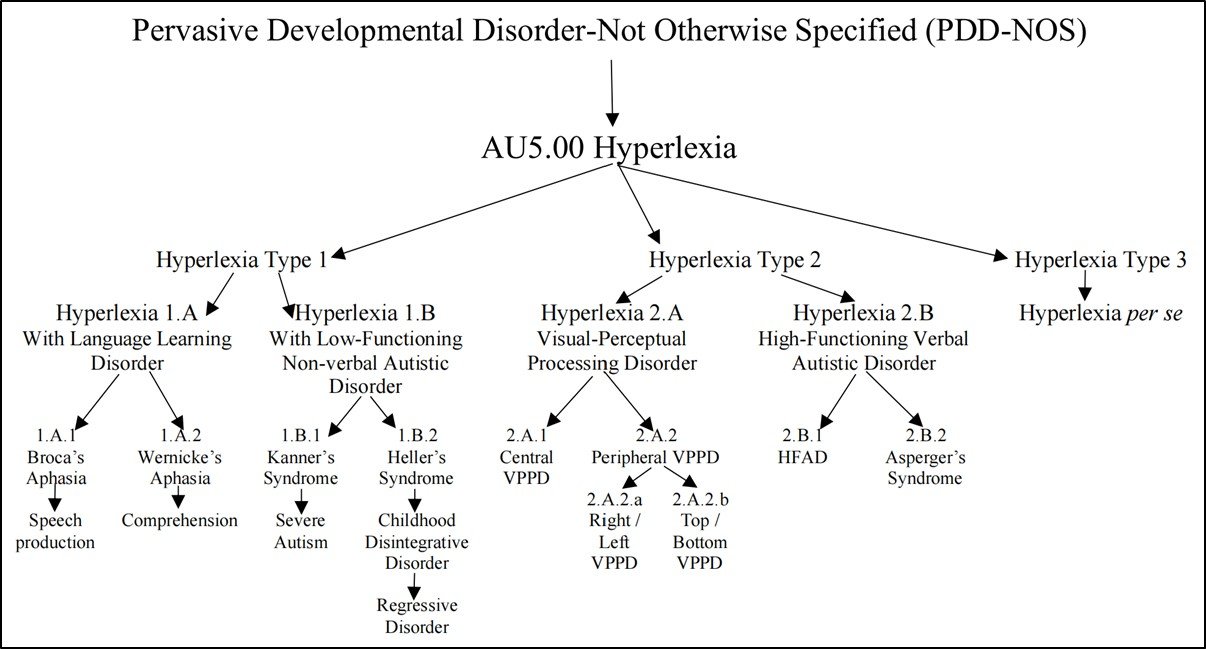
Hyperlexia has often, though not always, been associated with the autism spectrum disorder (ASD). While the disorder is regarded as a ‘splinter skill’ - a unique skill but without much practical application - with precocious reading ability (more like barking at print) but no real understanding of what is read. It becomes a enigma in itself between superior word recognition and/or decoding and deficient reading and/or listening comprehension. In this short paper, the author has chosen to cover briefly on the three developmental phases of hyperlexia research from the awareness through recognition to conceptualization, but paid more attention on five underlying theoretical concepts of hyperlexia and the five-level symptomatic nosology of the condition of hyperlexia.
References
Aaron, P. G. (1989). Dyslexia and hyperlexia: Diagnosis and management of developmental reading disabilities. Dordrecht, the Netherlands: Kluwer Academic. DOI: https://doi.org/10.1007/978-94-009-1065-2
Aaron, P. G. (1997). Hyperlexia: Reading without meaning in young children. Topics in Language Disorders, 17(3), 1-33. DOI: https://doi.org/10.1097/00011363-199705000-00003
American Hyperlexia Association (2005). Semantic pragmatic disorder. Retrieved from: http://www.hyperlexia.org/spl.html.
Åsberg, J., Gillberg, C., & Kopp, S. (2019). A hyperlexic-like reading style is associated with increased autistic features in girls with ADHD. Journal of Attention Disorders, 23(8), 767-776. DOI: https://doi.org/10.1177/1087054716685838
Autism Support Network (2002). Hyperlexia. Retrieved from: http://www.bbbautism.com/other_conditions.htm.
Baron-Cohen, S. (1999). Mindblindness: An essay on autism and theory of mind. London, U.K.: MIT Press.
Brennan, D, (2021, October 25). What is hyperlexia? In WebMD. Retrieved from: https://www.webmd.com/children/what-is-hyperlexia.
Brown, R. W. (2016). Hyperlexia: Related to vision and language problems. In NLDline. Retrieved from: http://www.nldline.com/hyperlexia.htm.
Burd, L., & Kerbeshian, J. (1985). Hyperlexia and a variant of hypergraphia. Perceptual and Motor Skills, 60, 940-942. DOI: https://doi.org/10.2466/pms.1985.60.3.940
Burd, L., Kerbeshiian, J., & Fisher, W. (1985). Inquiry into the incidence of hyperlexia in a state-wide population of children with pervasive developmental disorder. Psychological Reports, 57, 236-238. DOI: https://doi.org/10.2466/pr0.1985.57.1.236
Chi, F. M. (1995). EFL readers and a focus on inter-textuality. Journal of Reading, 38(8), 638-644.
Chia, K. H. (1995). Words without meaning. Montessori Education, 7(3), 18-19.
Chia, K. H. (1996). Hyperlexia: A deficit of inter-textuality in reading comprehension. Education Today, 46(2), 66-71.
Chia, K. H. (2000). The four theoretical concepts of hyperlexia. Health Digest, 12(6), 30-37.
Chia, K. H., & Chua, A. C. K. (2014, Spring). A brief examination of an autistic mind: From mindsight to mind blindness, from mindfulness to mindlessness. Unlimited Human! 4-7.
Chia, K. H., Poh, P. T. C., & Ng, A, G. T. (2009 Winter). Identifying and differentiating children with hyperlexia and its subtypes: A meta-analysis of results from WISC-III subtests and standardized reading tests. Journal of the American Academy of Special Education Professionals, 71-99. DOI: https://doi.org/10.64546/jaasep.70
Cobrinik, L. (1974). Unusual reading ability in severely disturbed children. Journal of Autism and Childhood Schizophrenia, 4, 163-175. DOI: https://doi.org/10.1007/BF02105368
De Beaugrande, R. (1980). Text, discourse and process. Norwood, NJ: Ablex.
Elliott, D. E., and Needleman, R.M. (1976). The syndrome of hyperlexia. Brain and Language, 3, 339-349. DOI: https://doi.org/10.1016/0093-934X(76)90030-4
Gough, P. B., and Tunmer, W. (1986). Decoding, reading, and reading disability. Remedial and Special Education, 7(1), 6-10. DOI: https://doi.org/10.1177/074193258600700104
Grigorenko, E. L., Klin, A., Pauls, D. L., Senft, R., Hooper, C., & Volkmar, F. (2003). A descriptive study of hyperlexia in a clinically referred sample of children with developmental delays. Journal of Autism and Developmental Disorders, 32, 3-12. DOI: https://doi.org/10.1023/A:1017995805511
Grigorenko, E. L., Klin, A., & Volkmar, F. (2003). Annotation: Hyperlexia: disability or superability? Journal of Child Psychology and Psychiatry, 44(8), 1079-1091. DOI: https://doi.org/10.1111/1469-7610.00193
Healy, J. (1982). The enigma of hyperlexia. Reading Research Quarterly, 17, 319-338. DOI: https://doi.org/10.2307/747522
Healy, J. M., Aram, D. M., Horwitz, S. J., and Kessler, J. W. (1982). A study of hyperlexia. Brain and Language, 17, 1-23. DOI: https://doi.org/10.1016/0093-934X(82)90001-3
Jones, C. R., Happé, F., Golden, H., Marsden, A. J., Tregay, J., Simonoff, E., ... & Charman, T. (2009). Reading and arithmetic in adolescents with autism spectrum disorders: Peaks and dips in attainment. Neuropsychology, 23, 718-728. DOI: https://doi.org/10.1037/a0016360
Kristeva, J. (1980). Desire in language: A semiotic approach to literature and art. New York, NY: Columbia University Press.
Leavell, C. (1998). Identifying and managing a child with a nonverbal learning disability. Part 1: Diagnosis and assessment of the nonverbal learning disabled child. Learning Disabilities Journal, 8(6), 4-7.
Macdonald, D., Luk, G., & Quintin, E. M. (2022). Early reading comprehension intervention for preschoolers with autism spectrum disorder and hyperlexia. Journal of Autism and Developmental Disorders, 52(4), 1652-1672. DOI: https://doi.org/10.1007/s10803-021-05057-x
Mammarella, V., Arigliani, E., Giovannone, F., Cavalli, G., Tofani, M., & Sogos, C. (2022). Is it hyperlexia? Toward a deeper understanding of precocious reading skills in two cases of children with Autism Spectrum Disorder. La Clinica Terapeutica, 173(1), 15-21.
Manzo, A. V., and Manzo, U. C. (1994). Literacy disorders: Holistic diagnosis and remediation. Orlando, FL: Holt, Rinehart and Winston.
Myklebust, H.R. (1975). Nonverbal learning disabilities: Assessment and intervention. In H. R. Myklebust (Ed.), Progress in learning disabilities: Vol.3. New York, NY: Grune and Stratton.
Nation, K., Clarke, P., Wright, B., & Williams, C. (2006). Patterns of reading ability in children with autism spectrum disorder. Journal of Autism and Developmental Disorders, 36, 911-919. DOI: https://doi.org/10.1007/s10803-006-0130-1
Newman, T. M., Macomber, D., Naples, A. J., Babitz, T., Volkmar, F., & Grigorenko, E. L. (2007). Hyperlexia in children with autism spectrum disorders. Journal of Autism and Developmental Disorders, 37(4), 760-774. DOI: https://doi.org/10.1007/s10803-006-0206-y
Niensted, S. M. (1968). Hyperlexia: An educational disease? Exceptional Children, 35(2), 162-163. DOI: https://doi.org/10.1177/001440296803500210
Pennington, B. F. (1991). Diagnosing learning disorders: A neuropsychological framework. New York, NY: Guilford Press.
Philips, A. (1930). Talented imbeciles. Psychology Clinics, 18, 246-265.
Pierangelo, R., and Giuliani, G. (2007). EDM: The educator’s diagnostic manual of disabilities and disorders. San Francisco, CA: John Wiley and Sons.
Richman, L. (1997). Peaceful co-existence: Autism, Asperger’s, hyperlexia. Retrieved from: http://www.hyperlexia.org/aha_winter9697.html.
Silberberg, N. E., & Silberberg, M. C. (1967). Hyperlexia-Specific word recognition skills in young Children. Exceptional Children, 34, 41-42. DOI: https://doi.org/10.1177/001440296703400106
Silberberg, N. E., & Silberberg, M. C. (1968). Case histories in hyperlexia. Journal of School Psychology, 7(1), 3-7. DOI: https://doi.org/10.1016/0022-4405(68)90110-6
Snowling, M., and Frith, U. (1986). Comprehension in hyperlexic readers. Journal of Experimental Child Psychology, 42, 392-415. DOI: https://doi.org/10.1016/0022-0965(86)90033-0
Tan-Niam, C. (2003). The false belief paradigm and theories of development. In C. Tan-Niam, S. Degotardi, and S. Dockett (Eds.), MINDS@PLAY: Inter-subjectivity, theory of mind and social competence in children’s interaction. Singapore: National Institute of Education/Nanyang Technological University.
Treffert, D. A. (2011). Hyperlexia III: Separating ‘autistic-like’behaviors from autistic disorder; Assessing children who read early or speak late. World Medical Journal, 110(6), 281-286.
Trevarthen, C. (1980). Instincts for human understanding and for cultural cooperation: Their development in infancy. In M. von Cranach, K. Fopps, K. Lepenies, and D. Ploog (Eds.), Human ethnology: Claims and limits of a new discipline. Cambridge, U.K.: Cambridge University Press.
Turkeltaub, P. E., Flowers, D. L., Verbalis, A., Miranda, M., Gareau, L., & Eden, G. F. (2004). The neural basis of hyperlexic reading: An fMRI case study. Neuron, 41, pp 1-20. DOI: https://doi.org/10.1016/S0896-6273(03)00803-1
Tyre, C., & Young, P. (1994). Specific learning difficulties. Staffordshire, U.K.: Q.Ed.
Wei, X., Christiano, E. R., Jennifer, W. Y., Wagner, M., & Spiker, D. (2015). Reading and math achievement profiles and longitudinal growth trajectories of children with an autism spectrum disorder. Autism, 19, 1-11. DOI: https://doi.org/10.1177/1362361313516549
Whitehouse, D., & Harris, J. (1984). Hyperlexia in infantile autism. Journal of Autism and Developmental Disorders, 14, 281-289. DOI: https://doi.org/10.1007/BF02409579
Wong, R. Y. K. (2010). Understanding the complexities of hyperlexia and its subtypes. Journal of Reading and Literacy, 2, 80-83.
Xie, G. H. (2022). The unpublished classification of hyperlexia and its three subtypes. Singapore: The Author.
Xie, G. H. (2023, March 14). Nosology and nosography of hyperlexia subtypes. In the IACT-approved Registered Educational Therapist Training Program: Module 1 - Hyperlexia. Singapore: The Author.
Zhang, S., & Joshi, R. M. (2019). Profile of hyperlexia: Reconciling conflict through a systematic review and meta-analysis. Journal of Neurolinguistics, 49, 1-28. DOI: https://doi.org/10.1016/j.jneuroling.2018.08.001
Downloads
Published
How to Cite
Issue
Section
License
Copyright (c) 2023 The Asian Educational Therapist

This work is licensed under a Creative Commons Attribution 4.0 International License.