A Prelude to Understanding Cognitive Disabilities in Cattell-Horn-Carroll Framework
DOI:
https://doi.org/10.64663/aet.75Keywords:
CHC Theory, Cognitive Abilities, Cognitive disability, Intellectual disabilityAbstract
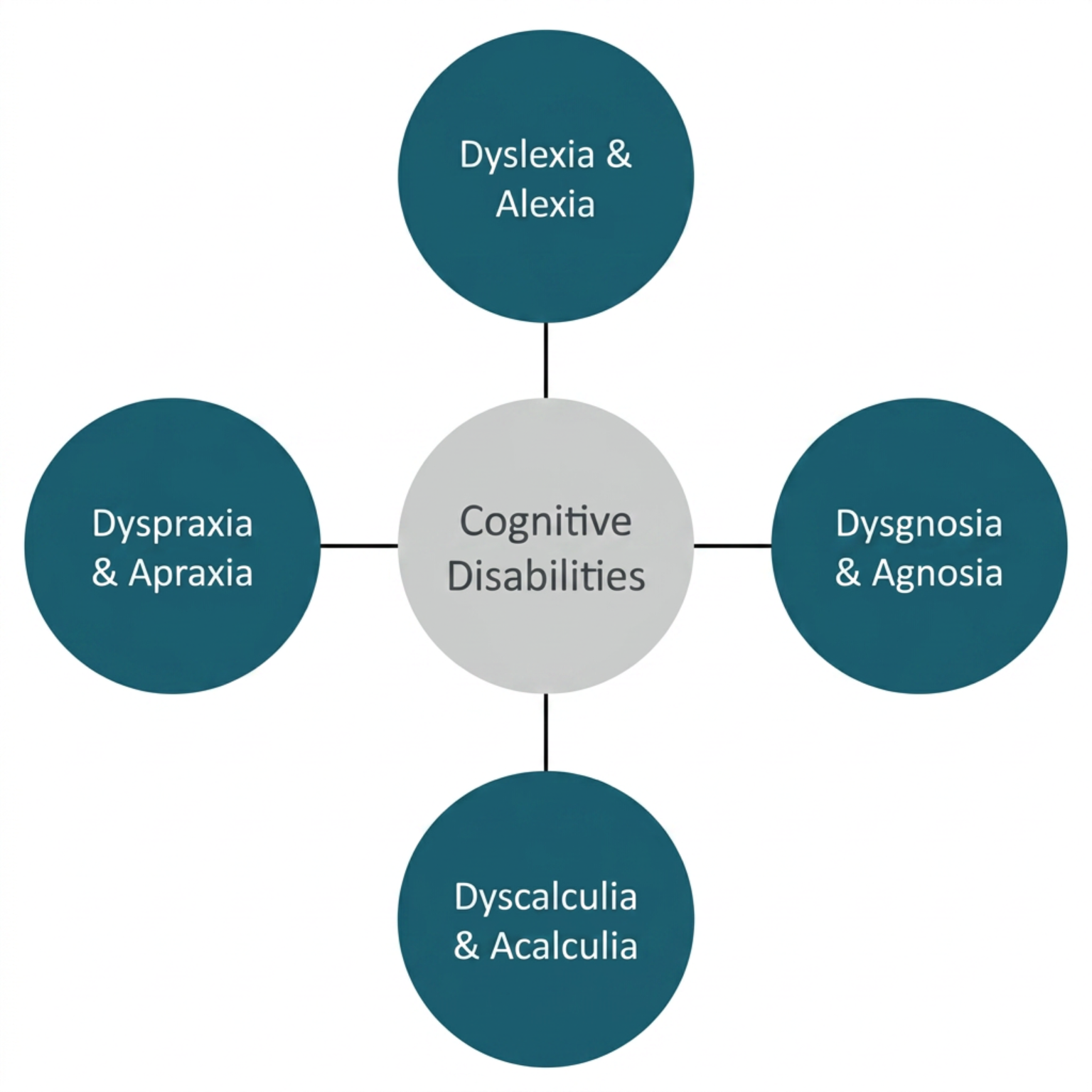
This article is a prelude to the application of the Cattell-Horn-Carroll (CHC) theory in the assessment and intervention for school-age children with cognitive disabilities (CogDs). This is the most common disability type identified by special education officers, school counselors and/or psychologists among school-age children. CogDs (also known as intellectual disabilities or IDs for short) is a nebulous term that describes an individual who exhibits more than average difficulty with intellectual tasks. In defining CogDs, there are several overlaps between developmental and CogDs. These are broad terms used in literature but these labels do not indicate the level of ability or skills. Within the framework of cognition, there are four cognitive subcategories involving what are termed as (i) lexikos (ability to use and understand language and literacy skills), (ii) calculatos (ability to use and understand mathematics and numeracy skills), (iii) praxis (ability to perform voluntary skilled movements), and (iv) gnosis (ability to acquire knowledge and its meaning of self and the context in which self-engages). In each subcategory, there are two types of challenging cognitive issues: one is concerned with developmental delay (i.e., dyslexia, dyscalculia, dyspraxia and dysgnosia), and the other is concerned with neurological lesion or injury (i.e., alexia, acalculia, apraxia and agnosia). In this article, the authors re-examined the framework of CogDs, and also its related four subcategories to the Cattell-Horn-Carroll (CHC) theory of broad cognitive abilities.
References
1. Poland, R. G. (1974). Human experience: A psychology of growth. Saint Louis, CO: CV Mosby. Available from: https://books.google.com.sg/books/about/Human_Experience.html?id=DhkNAAAAIAAJ&redir_esc=y
2. McGue, M., & Bouchard, T. J., Jr (1998). Genetic and environmental influences on human behavioral differences. Annual Review of Neuroscience, 21, 1-24. https://doi.org/10.1146/annurev.neuro.21.1.1 DOI: https://doi.org/10.1146/annurev.neuro.21.1.1
3. Newman, B. M., & Newman, P. R. (2020). Theories of adolescent development. New York: Academic Press. https://doi.org/10.1016/C2017-0-03324-4 DOI: https://doi.org/10.1016/C2017-0-03324-4
4. Plomin, R. (1999). Genetics and general cognitive ability. Nature, 402(Suppl 6761), C25-C29. https://doi.org/10.1038/35011520 DOI: https://doi.org/10.1038/35011520
5. WHO, World Health Organization. 1980. The international classification of impairments, disabilities, and handicaps (ICIDH). Geneva, Switzerland: The Author. Available from: https://archive.org/details/internationalcla0000worl_d9c0
6. APA, American Psychiatric Association (2013). Diagnostic and statistical manual of mental disorders-5th edition (DSM-5). Arlington, VA: American Psychiatric Publishing. https://doi.org/10.1176/appi.books.9780890425596 DOI: https://doi.org/10.1176/appi.books.9780890425596
7. AAIDD, American Association on Intellectual and Developmental Disabilities (2022). Defining criteria for intellectual disability. Retrieved from: https://www.aaidd.org/intellectual-disability/definition
8. Sparrow, S. S., Cicchetti, D. V., & Saulnier, C. A. (2016). Vineland adaptive behavior scales-3rd edition (Vineland-3). San Antonio, TX: Pearson. Available from: https://www.pearsonassessments.com/en-us/Store/Professional-Assessments/Behavior/Vineland-Adaptive-Behavior-Scales-%7C-Third-Edition/p/100001622
9. Tassé, M. J., Schalock, R. L., Balboni, G., Bersani, H., Borthwick-Duffy, S. A., Spreat, S., … & Zhang, D. (2017). Diagnostic adaptive behavior scale (DABS): Manual. Washington, DC: American Association on Intellectual and Developmental Disabilities. https://doi.org/10.1037/t52454-000 DOI: https://doi.org/10.1037/t52454-000
10. Tassé, M. J., Schalock, R. L., Balboni, G., Bersani, H., Jr, Borthwick-Duffy, S. A., Spreat, S., Thissen, D., Widaman, K. F., & Zhang, D. (2012). The construct of adaptive behavior: its conceptualization, measurement, and use in the field of intellectual disability. American Journal on Intellectual and Developmental Disabilities, 117(4), 291-303. https://doi.org/10.1352/1944-7558-117.4.291 DOI: https://doi.org/10.1352/1944-7558-117.4.291
11. Chia, K. H. (2010). Counselling students with special needs. Singapore: Pearson Education. Available from: https://www.cobee.com.sg/counselling-students-with-special-needs
12. Cormier, D. C., McGrew, K. S., Bulut, O., & Funamoto, A. (2016). Revisiting the relations between the WJ-IV measures of Cattell-Horn-Carroll (CHC) cognitive abilities and reading achievement during the school-age years. Journal of Psychoeducational Assessment, 35(8), 769-788. https://doi.org/10.1177/0734282916659208 DOI: https://doi.org/10.1177/0734282916659208
13. Moll, K., Göbel, S. M., Gooch, D., Landerl, K., & Snowling, M. J. (2016). Cognitive risk factors for specific learning disorder: Processing speed, temporal processing, and working memory. Journal of Learning Disabilities, 49(3), 272-281. https://doi.org/10.1177/0022219414547221 DOI: https://doi.org/10.1177/0022219414547221
14. López-Resa, P., & Moraleda-Sepúlveda, E. (2023) Working memory capacity and text comprehension performance in children with dyslexia and dyscalculia: A pilot study. Frontiers in Psychology, 14. Article ID: 1191304. https://doi.org/10.3389/fpsyg.2023.1191304 DOI: https://doi.org/10.3389/fpsyg.2023.1191304
15. CDC, Centers for Disease Control and Prevention (CDC) (2022, April 29). Developmental disabilities. Retrieved from: https://www.cdc.gov/ncbddd/developmentaldisabilities/index.html.
16. Pierangelo, R., & Giuliani, G. (2007). EDM: The educator’s diagnostic manual of disabilities and disorders. San Francisco, CA: John Wiley & Sons. Available from: https://www.amazon.sg/dp/0787978124?ref_=mr_referred_us_sg_sg
17. Flanagan, D. P., Ortiz, S. O., & Alfonso, V. C. (2013). Essentials of cross-battery assessment (3rd ed.). Hoboken, MJ: John Wiley & Sons. Available from: https://www.wiley.com/en-us/Essentials+of+Cross-Battery+Assessment%2C+3rd+Edition-p-9780470621950
18. Cattell, R. B. (1957). Personality and motivation structure and measurement. New York, NY: World Book. https://doi.org/10.1017/S0033312300003902 DOI: https://doi.org/10.1017/S0033312300003902
19. Cattell, R. B. (1971). Abilities: Their structure, growth, and action. Boston, MA: Houghton Mifflin. https://www.scirp.org/reference/referencespapers?referenceid=3591342
20. Horn, J. L. (1967). Intelligence: Why it grows, why it declines. Transaction, 5, 23-31. https://doi.org/10.1007/BF03180091 DOI: https://doi.org/10.1007/BF03180091
21. Horn, J. L. (1991). Measurement of intellectual capabilities: A review of theory. In K. S. McGrew, J. K. Werder, & R. W. Woodcock (Eds.), Woodcock-Johnson technical manual (pp. 197-232). Chicago, IL: Riverside. Available from: https://www.scirp.org/reference/ReferencesPapers?ReferenceID=1343101
22. Horn, J. L., & Stankov, L. (1982). Auditory and visual factors of intelligence. Intelligence, 6, 165-185. https://doi.org/10.1016/0160-2896(82)90012-5 DOI: https://doi.org/10.1016/0160-2896(82)90012-5
23. Chia, K. H. (2007). Bridging reading and writing: A cognitive equation of literacy. ASCD Review, 13, 5-12. https://doi.org/10.5281/zenodo.15853939
24. Lyon, G. R., Shaywitz, S. E., & Shaywitz, B. A. (2003). A definition of dyslexia. Annals of Dyslexia, 53(1), 1-14. https://doi.org/10.1007/s11881-003-0001-9 DOI: https://doi.org/10.1007/s11881-003-0001-9
25. Friedman, R., Ween, J. E., & Albert, M. L. (1993). Alexia. In K. M. Heilman, & E. V. Valenstein (Eds.), Clinical neuropsychology (pp. 37-62). New York, NY: Oxford University Press. Available from: https://psycnet.apa.org/record/1994-97210-002
26. De Carvalho, C. A. F., Kida, A. d. S. B., Capellini, S. A., & de Avila, C. R. B. (2014). Phonological working memory and reading in students with dyslexia. Frontiers in Psychology, 5. Article 746. https://doi.org/10.3389/fpsyg.2014.00746 DOI: https://doi.org/10.3389/fpsyg.2014.00746
27. De Oliveira, D. G., da Silva, P. B., Dias, N. M., Seabra, A. G., & Macedo, E. C. (2014). Reading component skills in dyslexia: word recognition, comprehension and processing speed. Frontiers in Psychology, 5. Article No. 1339. https://doi.org/10.3389/fpsyg.2014.01339 DOI: https://doi.org/10.3389/fpsyg.2014.01339
28. Wang, X., Huo, S., Wu, K. C., Mo, J., Wong, W. L., & Maurer, U. (2022). Behavioral and neurophysiological aspects of working memory impairment in children with dyslexia. Scientific Reports, 12. Article ID: 12571. https://doi.org/10.1038/s41598-022-16729-8 DOI: https://doi.org/10.1038/s41598-022-16729-8
29. Beauvois, M. F., & Derouesne, J. (1981). Lexical or orthographic agraphia. Brain, 104(1), 21-49. https://doi.org/10.1093/brain/104.1.21 DOI: https://doi.org/10.1093/brain/104.1.21
30. Miller, K. (2021, October 26). What is dyscalculia? What should I do if my child has it? WebMD Facts. Retrieved from: https://www.webmd.com/add-adhd/childhood-adhd/dyscalculia-facts#1.
31. Ardila, A., & Rosselli, M. (2002). Acalculia and dyscalculia. Neuropsychology Review, 12(4), 179-231. https://doi.org/10.1023/A:1021343508573 DOI: https://doi.org/10.1023/A:1021343508573
32. Libet, B., Gleason, C. A., Wright, E. W., & Pearl, D. K. (1983). Time of conscious intention to act in relation to onset of cerebral activity (readiness-potential). The unconscious initiation of a freely voluntary act. Brain, 106 (Pt 3), 623-642. https://doi.org/10.1093/brain/106.3.623 DOI: https://doi.org/10.1093/brain/106.3.623
33. Libet, B. (1985). Unconscious cerebral initiative and the role of conscious will in voluntary action. Behavioral and Brain Sciences, 8(4), 529-566. https://doi.org/10.1017/S0140525X00044903 DOI: https://doi.org/10.1017/S0140525X00044903
34. Wegner, D. M. (2003). The mind's best trick: How we experience conscious will. Trends in Cognitive Sciences, 7(2), 65–69. https://doi.org/10.1016/S1364-6613(03)00002-0 DOI: https://doi.org/10.1016/S1364-6613(03)00002-0
35. Wegner, D. M. (2004). Précis of ‘The illusion of conscious will.’ Behavioral and Brain Sciences, 27(5), 649=659. https://doi.org/10.1017/S0140525X04000159 DOI: https://doi.org/10.1017/S0140525X04000159
36. De Renzi, E., & Faglioni, P. (2020). Apraxia. In G. Denes & L. Pizzamiglio (Eds.), Handbook of clinical and experimental neuropsychology (pp. 421-440). London, UK: Psychology Press. https://doi.org/10.4324/9781315791272 DOI: https://doi.org/10.4324/9781315791272-23
37. Heilman, K. M., Watson, R. T., & Gonzalez-Rothi, L. J. (2007). Praxis. In C. G. Goetz (Ed.), Textbook of clinical neurology (3rd ed.) (pp. 55-62). Philadelphia, PA: Saunders Elsevier. https://doi.org/10.1016/B978-1-4160-3618-0.X1000-4 DOI: https://doi.org/10.1016/B978-141603618-0.10004-9
38. Rudolph, K. (2001). Gnosis: The nature and history of Gnosticism. London, UK: A & C Black. Available from: https://books.google.com.sg/books/about/Gnosis.html?id=3XxxkESCWz4C&redir_esc=y
39. Brakke, D. (2010). The Gnostics: Myth, ritual, and diversity in early Christianity. Choice Reviews (Online), Vol. 48 (pp. 18-51). Cambridge, MA: Harvard University Press. https://doi.org/10.2307/j.ctvjnrvhh DOI: https://doi.org/10.2307/j.ctvjnrvhh
40. Ehrman, B. D. (2003). Chapter 6: Christians in the know: The worlds of early Christian Gnosticism. In B. D. Ehrman (Ed.), Lost Christianities: The battles for scripture and the faiths we never knew. (pp. 113-134). New York, NY: Oxford University Press. https://doi.org/10.1093/oso/9780195141832.003.0007 DOI: https://doi.org/10.1093/oso/9780195141832.003.0007
41. May, G. (2008). Part V: The shaping of Christian theology - Monotheism and creation. In M. M. Mitchell & F. M. Young (Eds.). The Cambridge history of Christianity, Vol. 1: Origins to Constantine (pp. 434-456). Cambridge, UK: Cambridge University Press. Available from: https://books.google.com.sg/books/about/Cambridge_History_of_Christianity_Volume.html?id=6UTfmw_zStsC&redir_esc=y
42. Price, A. W. (2008). Contextuality in practical reason. Oxford, UK: Oxford University Press. https://doi.org/10.1093/acprof:oso/9780199534791.001.0001 DOI: https://doi.org/10.1093/acprof:oso/9780199534791.001.0001
43. Jaynes, J. (1976). The origin of consciousness in the breakdown of the bicameral mind. Boston, MA: Houghton Mifflin Harcourt. Available from https://www.amazon.com/Origin-Consciousness-Breakdown-Bicameral-Mind/dp/0395207290
44. Farah M. J. (1992). Agnosia. Current Opinion in Neurobiology, 2(2), 162-164. https://doi.org/10.1016/0959-4388(92)90005-6 DOI: https://doi.org/10.1016/0959-4388(92)90005-6
45. Konen, C. S., Behrmann, M., Nishimura, M., & Kastner, S. (2011). The functional neuroanatomy of object agnosia: a case study. Neuron, 71(1), 49-60. https://doi.org/10.1016/j.neuron.2011.05.030 DOI: https://doi.org/10.1016/j.neuron.2011.05.030
46. Damasio, A. R., Tranel, D., & Damasio, H. (1990). Face agnosia and the neural substrates of memory. Annual Review of Neuroscience, 13(1), 89-109. https://doi.org/10.1146/annurev.ne.13.030190.000513 DOI: https://doi.org/10.1146/annurev.ne.13.030190.000513
47. Shell, A. R. (2015). Auditory agnosia. In M. J. Aminoff, F. Boller, & D. F. Swaab (Eds.), Handbook of clinical neurology (Vol. 129; pp. 573-587). Waltham, MA: Elsevier B. V. https://doi.org/10.1016/B978-0-444-62630-1.00032-9 DOI: https://doi.org/10.1016/B978-0-444-62630-1.00032-9
48. Milner, A. D., Perrett, D. I., Johnston, R. S., Benson, P. J., Jordan, T. R., Heeley, D. W., Bettucci, D., Mortara, F., Mutani, R., & Terazzi, E. (1991). Perception and action in ‘visual form agnosia’. Brain, 114 ( Pt 1B), 405-428. https://doi.org/10.1093/brain/114.1.405 DOI: https://doi.org/10.1093/brain/114.1.405
49. Pryse-Phillips, W. (1975). Olfaction and its disorders: Disturbance in the sense of smell in psychiatric patients. Journal of the Royal Society of Medicine, 68(8), 472-474. https://doi.org/10.1177/003591577506800 DOI: https://doi.org/10.1177/003591577506800803
50. Schneider, W. J., & McGrew, K. S. (2018). The Cattell–Horn–Carroll theory of cognitive abilities. In D. P. Flanagan & E. M. McDonough (Eds.), Contemporary intellectual assessment: Theories, tests, and issues (4th ed., pp. 73-163). New York, NY: The Guilford Press. Available from: https://psycnet.apa.org/record/2018-36604-003
51. McGill, R. J., & Busse, R. T. (2017). When theory trumps science: A critique of the PSW model for SLD identification. Contemporary School Psychology, 21, 10-18. https://doi.org/10.1007/s40688-016-0094-x DOI: https://doi.org/10.1007/s40688-016-0094-x
52. Swanson, H. L., Harris, K. R., & Graham, S. (Eds.). (2014). Handbook of learning disabilities (2nd ed.). New York, NY: Guilford Press. Available from https://www.amazon.com/Handbook-Learning-Disabilities-Second-Swanson/dp/1462518680
53. Peng, P., & Fuchs, D. (2016). A meta-analysis of working memory deficits in children with learning difficulties: Is there a difference between verbal domain and numerical domain?. Journal of Learning Disabilities, 49(1), 3-20. https://doi.org/10.1177/0022219414521667 DOI: https://doi.org/10.1177/0022219414521667
54. Radtke, B. M., Łada-Maśko, A. B., Jurek, P., Olech, M., & Sajewicz-Radtke, U. (2026). Beyond reading and spelling: Exploring intelligence profiles in individuals with dyslexia through a Cattell-Horn-Carroll theory lens. Health Psychology Report, 14(2), 123-132. https://doi.org/10.5114/hpr/205989 DOI: https://doi.org/10.5114/hpr/205989
55. UNESCO (2020). Global education monitoring report 2020: Inclusion and education – All means all. Paris, France: UNESCO Publishing. https://doi.org/10.54676/JJNK6989 Available from https://unesdoc.unesco.org/ark:/48223/pf0000373718 DOI: https://doi.org/10.54676/JJNK6989
Downloads
Published
How to Cite
Issue
Section
License
Copyright (c) 2026 Harjit SINGH, Kok Hwee CHIA, Chee Keong CHUA

This work is licensed under a Creative Commons Attribution 4.0 International License.