Toward an Integrated DDD Framework: Diagnostic, Dialogic, and Didactic Models in Hospital Healthcare Management
DOI:
https://doi.org/10.64663/aet.19Keywords:
Healthcare Management, Diagnostics-Dialogics-Didactics, Hospital ManagementAbstract
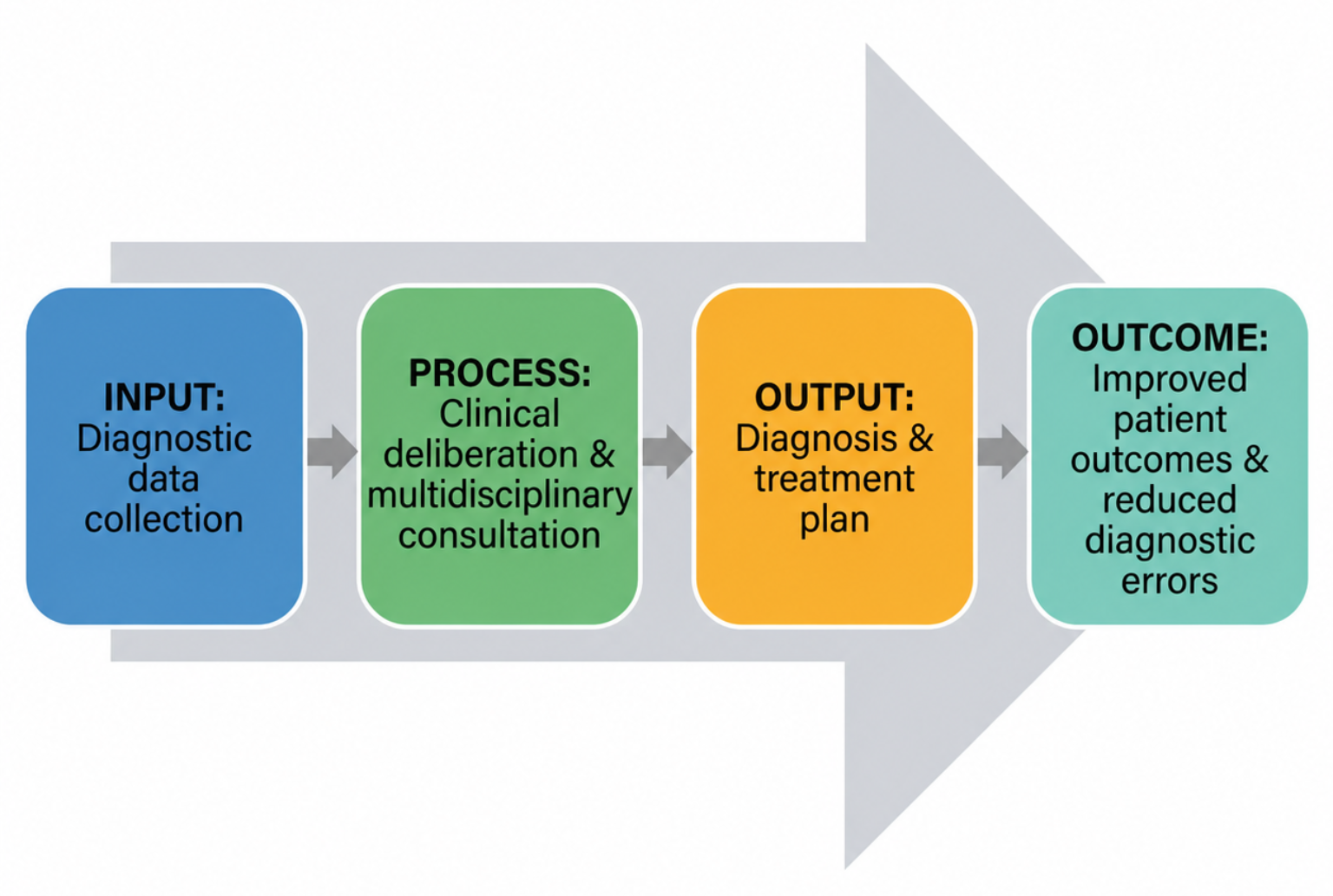
Modern hospital management requires integrated frameworks to address the growing complexity of patient care, technological advancements, and the emphasis on patient-centered outcomes. This conceptual paper presents the Diagnostics-Dialogics-Didactics (DDD) framework, which unites three interdependent dimensions of hospital practice: (i) diagnostic reasoning and data integration, (ii) dialogic communication among patients, caregivers, and healthcare teams, and (iii) didactic-didactic medical education that fosters professional learning. The Diagnostic Management Model illustrates how coordinated diagnostic workflows and interdisciplinary teams improve accuracy and reduce errors. Dialogic communication models demonstrate the value of shared decision-making and collaborative understanding, while the Dialogic-Didactic Education Model enhances reflective practice, clinical reasoning, and systems-based competencies among healthcare professionals. By integrating these approaches, the DDD framework provides both conceptual clarity and practical guidance for operationalizing high-quality, patient-centered, and sustainable hospital management systems.
References
Ayanian, J. Z., & Weissman, J. S. (2002). Teaching hospitals and quality of care: A review of the literature. The Milbank Quarterly, 80(3), 569-v. https://doi.org/10.1111/1468-0009.00023 DOI: https://doi.org/10.1111/1468-0009.00023
Berwick, D. M., Nolan, T. W., & Whittington, J. (2008). The triple aim: care, health, and cost. Health Affairs (Project Hope), 27(3), 759-769. https://doi.org/10.1377/hlthaff.27.3.759 DOI: https://doi.org/10.1377/hlthaff.27.3.759
Brashear, J., Mize, R., Laposata, M., & Zahner, C. (2024). Impact of diagnostic management team on patient time to diagnosis and percent of accurate and clinically actionable diagnoses. Diagnosis (Berlin, Germany), 11(2), 132-135. https://doi.org/10.1515/dx-2023-0175 DOI: https://doi.org/10.1515/dx-2023-0175
Donabedian, A. (2003). An introduction to quality assurance in health care. New York, NY: Oxford University Press. Available [online] from: https://catalog.nlm.nih.gov/discovery/fulldisplay/alma9911673673406676/01NLM_INST:01NLM_INST
Elwyn, G., Frosch, D., Thomson, R., Joseph-Williams, N., Lloyd, A., Kinnersley, P., Cording, E., Tomson, D., Dodd, C., Rollnick, S., Edwards, A., & Barry, M. (2012). Shared decision making: a model for clinical practice. Journal of General Internal Medicine, 27(10), 1361-1367. https://doi.org/10.1007/s11606-012-2077-6 DOI: https://doi.org/10.1007/s11606-012-2077-6
Epner, P. L., Gans, J. E., & Graber, M. L. (2013). When diagnostic testing leads to harm: A new outcomes-based approach for laboratory medicine. BMJ Quality & Safety, 22 Suppl 2(Suppl 2), ii6-ii10. https://doi.org/10.1136/bmjqs-2012-001621 DOI: https://doi.org/10.1136/bmjqs-2012-001621
Epstein, R. M., & Street, R. L., Jr (2011). The values and value of patient-centered care. Annals of Family Medicine, 9(2), 100-103. https://doi.org/10.1370/afm.1239 DOI: https://doi.org/10.1370/afm.1239
Hoque, F. (2024). Shared decision-making in patient care: Advantages, barriers and potential solutions. Journal of Brown Hospital Medicine, 3(4), 13-15. https://doi.org/10.56305/001c.122787 DOI: https://doi.org/10.56305/001c.122787
Irby, D. M., Cooke, M., & O'Brien, B. C. (2010). Calls for reform of medical education by the Carnegie Foundation for the Advancement of Teaching: 1910 and 2010. Academic Medicine: Journal of the Association of American Medical Colleges, 85(2), 220-227. https://doi.org/10.1097/ACM.0b013e3181c88449 DOI: https://doi.org/10.1097/ACM.0b013e3181c88449
Jensen, N. K., & Pals, R. A. (2015). A dialogue-based approach to patient education. Indian Journal of Endocrinology and Metabolism, 19(1), 168-170. https://doi.org/10.4103/2230-8210.146876 DOI: https://doi.org/10.4103/2230-8210.146876
Kuper, A., Boyd, V. A., Veinot, P., Abdelhalim, T., Bell, M. J., Feilchenfeld, Z., Najeeb, U., Piquette, D., Rawal, S., Wong, R., Wright, S. R., Whitehead, C. R., Kumagai, A. K., & Richardson, L. (2019). A dialogic approach to teaching person-centered care in graduate medical education. Journal of Graduate Medical Education, 11(4), 460-467. https://doi.org/10.4300/JGME-D-19-00085.1 DOI: https://doi.org/10.4300/JGME-D-19-00085.1
Laposata, M., & Dighe, A. (2007). "Pre-pre" and "post-post" analytical error: High-incidence patient safety hazards involving the clinical laboratory. Clinical Chemistry and Laboratory Medicine, 45(6), 712-719. https://doi.org/10.1515/CCLM.2007.173 DOI: https://doi.org/10.1515/CCLM.2007.173
Liao, K. C., & Peng, C. H. (2023). Evolving from didactic to dialogic: How to improve faculty development and support faculty developers by using action research. Teaching and Learning in Medicine, 36(2), 211-221. https://doi.org/10.1080/10401334.2023.2204091 DOI: https://doi.org/10.1080/10401334.2023.2204091
Lubin, I. M., Astles, J. R., Shahangian, S., Madison, B., Parry, R., Schmidt, R. L., & Rubinstein, M. L. (2021). Bringing the clinical laboratory into the strategy to advance diagnostic excellence. Diagnosis (Berlin, Germany), 8(3), 281-294. https://doi.org/10.1515/dx-2020-0119 DOI: https://doi.org/10.1515/dx-2020-0119
Steinert, Y. (2000). Faculty development in the new millennium: key challenges and future directions. Medical Teacher, 22(1), 44-50. https://doi.org/10.1080/01421590078814 DOI: https://doi.org/10.1080/01421590078814
Thornton-Bacon, C., Trent, P., & McCoy, T. P. (2018). Enhancing Systems Thinking for Undergraduate Nursing Students Using Friday Night at the ER. The Journal of nursing education, 57(11), 687-689. https://doi.org/10.3928/01484834-20181022-113. DOI: https://doi.org/10.3928/01484834-20181022-11
Wong, M. E., Chia, K. H., & Lim, B. H. (2015). A Triple-D model of primary case management system for special education. Asian Journal of Management Sciences & Education, 4(1), 12-22. https://doi.org/10.5281/zenodo.15455547
Downloads
Published
How to Cite
Issue
Section