
Addressing Seizure-Related Learning Disruptions in Childhood Absence Epilepsy using a 3-D Intervention Framework: A Case Report
DOI:
https://doi.org/10.64663/aet.93Keywords:
Childhood Absence Epilepsy, seizure-related learning disruption, educational therapy, specific intervention (3-D framework), case reportAbstract
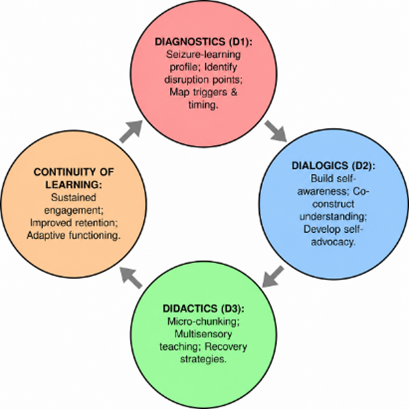
Childhood Absence Epilepsy (CAE) is a pediatric neurological condition characterized by frequent, brief episodes of impaired awareness that disrupt attention, memory, and learning continuity. This case report is unique in reframing attention difficulties in CAE as neurologically driven micro-disruptions rather than behavioral inattention and in demonstrating the application of a structured educational therapy framework. An 11-year-old boy diagnosed with CAE presented with frequent absence seizures associated with disrupted task initiation, reduced task continuity, impaired memory retention, and limited awareness of missed information, resulting in significant academic difficulties. An 8-week educational therapy intervention based on a 3-D framework (Diagnostics, Dialogics, and Didactics) was implemented to support learning continuity. Data were collected through structured observations, developmental assessment rubrics, and parent–teacher feedback. The intervention resulted in consistent improvement across key domains, including task initiation, task continuity, self-awareness, memory retention, and recovery after interruption, with the most marked gains observed in task initiation and memory retention. This case report highlights that learning disabilities in CAE are best understood as interruptions in cognitive continuity rather than deficits in ability. The findings demonstrate that a structured, neuro-informed educational therapy approach can effectively support learning despite ongoing neurological disruptions, with implications for integrating clinical and educational practice.
References
1. Rubboli G, Beier CP, Selmer KK, et al. Variation in prognosis and treatment outcome in juvenile myoclonic epilepsy: a Biology of Juvenile Myoclonic Epilepsy Consortium proposal for a practical definition and stratified medicine classifications. Brain Commun. 2023;5(3):fcad182. https://doi.org/10.1093/braincomms/fcad182. DOI: https://doi.org/10.1093/braincomms/fcad182
2. Wirrell EC, Camfield CS, Camfield PR, Gordon KE, Dooley JM. Long-term prognosis of typical childhood absence epilepsy: remission or progression to juvenile myoclonic epilepsy. Neurology. 1996;47(4):912-918. https://doi.org/10.1212/wnl.47.4.912 . DOI: https://doi.org/10.1212/WNL.47.4.912
3. e Souza GD, de Lanna Machado FS, Kimura TY, de Oliveira HL. Absence seizures in children and teenagers: ethosuximide, valproate or lamotrigine? A systematic review from 1999 to 2021. Brazilian Journal of Health Review. 2022 Jan;5(1):210-8. https://doi.org/10.34119/bjhrv5n1-019 . DOI: https://doi.org/10.34119/bjhrv5n1-019
4. Leitch B. Molecular mechanisms underlying the generation of absence seizures: identification of potential targets for therapeutic intervention. Int J Mol Sci. 2024 Sep 11;25(18):9821. https://doi.org/10.3390/ijms25189821 . DOI: https://doi.org/10.3390/ijms25189821
5. Kumar A, Lyzhko E, Hamid L, Srivastav A, Stephani U, Japaridze N. Neuronal networks underlying ictal and subclinical discharges in childhood absence epilepsy. J Neurol. 2023 Mar;270(3):1402-1415. https://doi.org/10.1007/s00415-022-11462-8 . DOI: https://doi.org/10.1007/s00415-022-11462-8
6. Mizuno K, Capparelli EV, Fukuda T, et al. Model-informed precision dosing guidance of ethosuximide developed from a randomized controlled clinical trial of childhood absence epilepsy. Clin Pharmacol Ther. 2023;114(2):459-469. https://doi.org/10.1002/cpt.2965 DOI: https://doi.org/10.1002/cpt.2965
7. Tenney JR, Glauser TA. The current state of absence epilepsy: can we have your attention?. Epilepsy Curr. 2013;13(3):135-140. https://doi.org/0.5698/1535-7511-13.3.135 . DOI: https://doi.org/10.5698/1535-7511-13.3.135
8. Caplan R, Siddarth P, Stahl L, et al. Childhood absence epilepsy: behavioral, cognitive, and linguistic comorbidities. Epilepsia. 2008;49(11):1838-1846. https://doi.org/10.1111/j.1528-1167.2008.01680.x. DOI: https://doi.org/10.1111/j.1528-1167.2008.01680.x
9. Chia KH, Tan MK, Jia X. Integrated pediatric and educational therapies framework. Asian J Pediatr Res. 2026;16(3):66-82. https://doi.org/10.9734/ajpr/2026/v16i3535 . DOI: https://doi.org/10.9734/ajpr/2026/v16i3535
10. Chia KH. Toward an integrated DDD framework: diagnostic, dialogic, and didactic models in hospital healthcare management. Asian Educ Ther. 2024;2(1):53-59. https://doi.org/10.64663/aet.19 DOI: https://doi.org/10.64663/aet.19
11. Gagnier JJ, Kienle G, Altman DG, Moher D, Sox H, Riley D. The CARE guidelines: consensus-based clinical case reporting guideline development. Global Adv in Health and Med. 2013 Sep;2(5):38-43. https://doi.org/10.3109/19390211.2013.830679 DOI: https://doi.org/10.7453/gahmj.2013.008
12. Bayram A. CARE (CAse REport) Guidelines: A recipe for more transparent case reports. Turk Arch Otorhinolaryngol. 2022;60(2):63-64. https://doi.org/10.4274/tao.2022.2022-01 DOI: https://doi.org/10.4274/tao.2022.2022-01
13. Chia KH. Centre for Exceptional Children: An alternative choice for children with special educational needs. ASCD Review. 2005;12(3):61-66. Available from: https://www.ascdsingapore.org/qws/slot/u50411/Publications/vol12-3.pdf
14. 14. Benson CH. Attention under attack: how the modern world steals focus and fragments the mind. eBookIt.com; 2026 May 31. https://www.amazon.co.jp/Attention-Under-Attack-Fragments-English-ebook/dp/B0H3Q1J9FF
15. Barone V, Van Putten MJ, Visser GH. Absence epilepsy: characteristics, pathophysiology, attention impairments, and the related risk of accidents. A narrative review. Epilepsy & Beh. 2020 Nov 1;112:107342. https://doi.org/10.1016/j.yebeh.2020.107342 DOI: https://doi.org/10.1016/j.yebeh.2020.107342
Downloads
Published
How to Cite
Issue
Section
License
Copyright (c) 2026 Kok Hwee CHIA, Hsing Hui TAN

This work is licensed under a Creative Commons Attribution 4.0 International License.