
Understanding Disorders: Insights into Phenotypes, Endophenotypes, Neurotypes, and Genotypes within the Context of the PENG Model
DOI:
https://doi.org/10.64663/aet.53Keywords:
Endophenotypes, Genotypes, Neurotypes, PENG model, PhenotypesAbstract
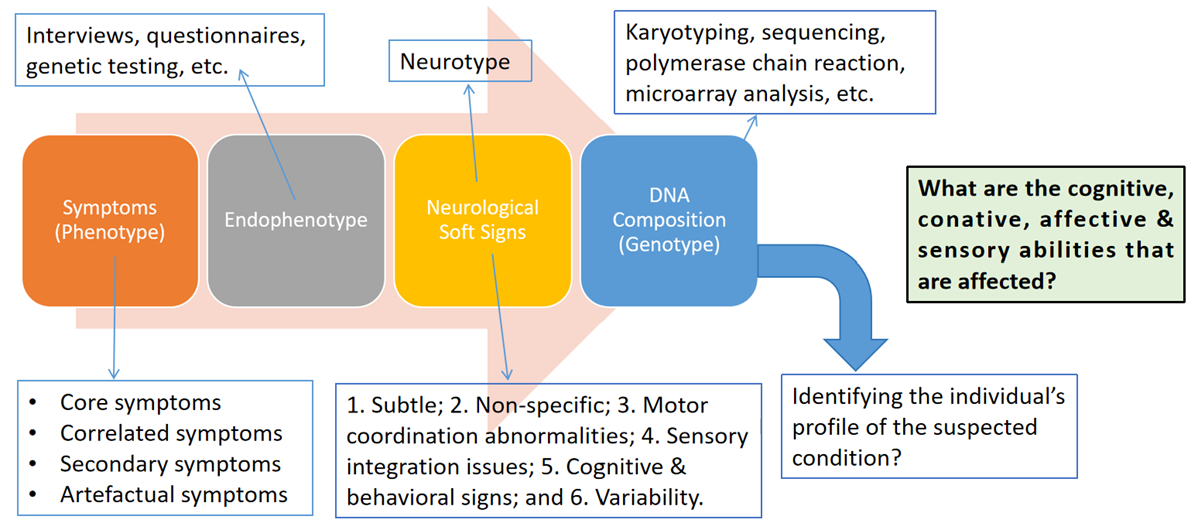
Advancements in neuroscience, genetics, and psychology have paved the way for a deeper understanding of human disorders and syndromes through the study of Phenotypes, Endophenotypes, Neurotypes, and Genotypes, collectively known as the PENG model. The framework of PENG provides critical insights into the complex interplay between biological, neurological, and behavioral factors, allowing for a more comprehensive understanding of individual and group differences. This approach enhances precision in diagnostics and fosters personalized treatment interventions, ultimately contributing to better clinical outcomes. As research continues to uncover these connections, it supports a shift towards more inclusive and compassionate approaches to mental health and neurodiversity, promising new pathways for individualized care and societal acceptance.
References
Bieber, T., Angelo, M. D., Akdis, C. A., Traidl-Hoffmann, C., Lauener, R., Schäppi, G., & Schmid-Grendelmeier, P. (2017). Clinical phenotypes and endophenotypes of atopic dermatitis: where are we, and where should we go?. Journal of Allergy and Clinical Immunology, 139(4), S58-S64. https://doi.org/10.1016/j.jaci.2017.01.008 DOI: https://doi.org/10.1016/j.jaci.2017.01.008
Brown, K. A., Parikh, S., & Patel, D. R. (2020). Understanding basic concepts of developmental diagnosis in children. Translational Pediatrics, 9(Suppl 1), S9-S22. https://doi.org/10.21037/tp.2019.11.04 DOI: https://doi.org/10.21037/tp.2019.11.04
Cassidy, S. B., & Morris, C. A. (2002) Behavioral phenotypes in genetic syndromes: Genetic clues to human behavior. Advances in Pediatrics, 49, 59-86. https://www.scribd.com/document/472884155/Behavioral-phenotypes-of-genetic-syndromes-with-in
Chauhan, T. (2019, January 23). What is genotype? Definition, frequency and methods. Genetic Education. Retrieved online: https://geneticeducation.co.in/what-is-a-genotype-definition-frequency-and-methods/
Chia, K. H. (2024, October 28). The significance of CHC human cognitive abilities based diagnostic assessment for learning disorders [Paper presentation]. 2024 China (Chengdu)-Singapore International Science and Technology Exchange Conference, Marina Bay Sands Expo & Convention Centre, Singapore.
Chia, K. H., & Lim, B. H (2016). Understanding how attention can be affected by different task behaviors. Unlimited Human! (Fall issue), 5-7 & 37.
Delgado-Lobete, L., Pértega-Díaz, S., Santos-del-Riego, S., & Montes-Montes, R. (2020). Sensory processing patterns in developmental coordination disorder, attention deficit hyperactivity disorder and typical development. Research in Developmental Disabilities, 100. Article ID: 103608. https://doi.org/10.1016/j.ridd.2020.103608 DOI: https://doi.org/10.1016/j.ridd.2020.103608
Dias, L., Schneider, B., & Bohrer, R. (2024, May). Neurotype cafe: A case study in neurodiverse self-representation. In Proceedings of the 19th International Conference on the Foundations of Digital Games (Article No. 42; pp. 1-4). New York, NY: Association for Computing Machinery. https://doi.org/10.1145/3649921.3656974 DOI: https://doi.org/10.1145/3649921.3656974
Doebel, S. (2020). Rethinking executive function and its development. Perspectives on Psychological Science, 15(4), 942-956. https://doi.org/10.1177/1745691620904771 DOI: https://doi.org/10.1177/1745691620904771
Gottesman, I. I., & Gould, T. D. (2003). The endophenotype concept in psychiatry: etymology and strategic intentions. The American Journal of Psychiatry, 160(4), 636-645. https://doi.org/10.1176/appi.ajp.160.4.636 DOI: https://doi.org/10.1176/appi.ajp.160.4.636
Grezenko, H., Ekhator, C., Nwabugwu, N. U., Ganga, H., Affaf, M., Abdelaziz, A. M., ... & Khaliq, A. S. (2023). Epigenetics in neurological and psychiatric disorders: A comprehensive review of current understanding and future perspectives. Cureus, 15(8). Article ID: 15(8):e43960. https://doi.org/10.7759/cureus.43960 DOI: https://doi.org/10.7759/cureus.43960
Jewsbury, P. A., Bowden, S. C., & Duff, K. (2017). The Cattell–Horn–Carroll model of cognition for clinical assessment. Journal of Psychoeducational Assessment, 35(6), 547-567. https://doi.org/10.1177/0734282916651360 DOI: https://doi.org/10.1177/0734282916651360
Johannsen, W. (1911). The genotype conception of heredity. The American Naturalist, 45(531), 129–159. Available online: http://www.jstor.org/stable/2455747 DOI: https://doi.org/10.1086/279202
Johannsen, W. (2014). The genotype conception of heredity. International Journal of Epidemiology, 43(4), 989-1000. https://doi.org/10.1086/279202 DOI: https://doi.org/10.1093/ije/dyu063
Karmiloff-Smith, A., Scerif, G., & Thomas, M. (2002). Different approaches to relating genotype to phenotype in developmental disorders. Developmental Psychobiology, 40(3), 311-322. https://doi.org/10.1002/dev.10035 DOI: https://doi.org/10.1002/dev.10035
Kendler, K. S., & Neale, M. C. (2010). Endophenotype: A conceptual analysis. Molecular Psychiatry, 15(8), 789–797. https://doi.org/10.1038/mp.2010.8 DOI: https://doi.org/10.1038/mp.2010.8
Kuffler, L., Skelly, D. A., Czechanski, A., Fortin, H. J., Munger, S. C., Baker, C. L., ... & Carter, G. W. (2024). Imputation of 3D genome structure by genetic–epigenetic interaction modeling in mice. Elife, 12. Article ID: RP88222. https://doi.org/10.7554/eLife.88222.3 DOI: https://doi.org/10.7554/eLife.88222.3
Lenzenweger, M. F. (2013). Thinking clearly about the endophenotype–intermediate phenotype–biomarker distinctions in developmental psychopathology research. Development and psychopathology, 25(4pt2), 1347-1357. https://doi.org/10.1017/S0954579413000655 DOI: https://doi.org/10.1017/S0954579413000655
Li, J., Han, R., Li, R., Xu, Q., Li, M., Tang, Y., ... & Li, L. (2023). iBP-seq: An efficient and low-cost multiplex targeted genotyping and epigenotyping system. The Crop Journal, 11(5), 1605-1610. https://doi.org/10.1016/j.cj.2023.03.012 DOI: https://doi.org/10.1016/j.cj.2023.03.012
McGill, R. J., & Dombrowski, S. C. (2019). Critically reflecting on the origins, evolution, and impact of the Cattell-Horn-Carroll (CHC) model. Applied Measurement in Education, 32(3), 216-231. https://doi.org/10.1080/08957347.2019.1619561 DOI: https://doi.org/10.1080/08957347.2019.1619561
McGrew, K. S. (2009). CHC theory and the human cognitive abilities project: Standing on the shoulders of the giants of psychometric intelligence research. Intelligence, 37(1), 1-10. https://doi.org/10.1016/j.intell.2008.08.004 DOI: https://doi.org/10.1016/j.intell.2008.08.004
Mefford, H. C. (2009). Genotype to phenotype—discovery and characterization of novel genomic disorders in a “genotype-first” era. Genetics in Medicine, 11(12), 836-842. https://doi.org/10.1097/GIM.0b013e3181c175d2 DOI: https://doi.org/10.1097/GIM.0b013e3181c175d2
Merlion Paediatric Therapy Clinic (2024). The PENG Model. InfoSheet: The PENG model. Singapore: The Author.
Merriam-Webster (n.d.). Neurological. In Merriam-Wbster.com medical dictionary. Retrieved online: https://www.merriam-webster.com/medical/neurological
Newton, P. M., & Salvi, A. (2020). How common is belief in the learning styles neuromyth, and does it matter? A pragmatic systematic review. Frontiers in Education, 5. Article ID: 602451). https://doi.org/10.3389/feduc.2020.602451 DOI: https://doi.org/10.3389/feduc.2020.602451
Niu, Z., Zhong, G., & Yu, H. (2021). A review on the attention mechanism of deep learning. Neurocomputing, 452, 48-62. https://doi.org/10.1016/j.neucom.2021.03.091 DOI: https://doi.org/10.1016/j.neucom.2021.03.091
Pennington, B. F. (1991). Diagnosing learning disorders: A neuropsychological framework. New York, NY: The Guilford Press. https://www.scirp.org/reference/referencespapers?referenceid=285882
Plack, M. M. (2024). The brain: Translating current concepts in brain science to inform the practice of teaching and learning. In M. M. Plack & M. Driscoll (Eds.), Teaching and learning in physical therapy (pp. 91-125). New York, NY: Routledge. https://doi.org/10.4324/9781003526704 DOI: https://doi.org/10.4324/9781003526704-5
Rogowsky, B. A., Calhoun, B. M., & Tallal, P. (2020). Providing instruction based on students’ learning style preferences does not improve learning. Frontiers in Psychology, 11. Article ID: 511773. https://doi.org/10.3389/fpsyg.2020.00164 DOI: https://doi.org/10.3389/fpsyg.2020.00164
Rudy, L. J. (2023, August 8). What does ‘neurotypical’ mean? Verywell Health. Retrieved online: https://www.verywellhealth.com/what-does-it-mean-to-be-neurotypical-260047
Schneider, W. J., & McGrew, K. S. (2018). The Cattell–Horn–Carroll theory of cognitive abilities. In D. P. Flanagan & E. M. McDonough (Eds.), Contemporary intellectual assessment: Theories, tests, and issues (4th ed., pp. 73–163). New York, NY: The Guilford Press. https://psycnet.apa.org/record/2018-36604-003
Sheppard, E., Webb, S., & Wilkinson, H. (2024). Mindreading beliefs in same-and cross-neurotype interactions. Autism, 28(7), 1828-1837. https://doi.org/10.1177/13623613231211457 DOI: https://doi.org/10.1177/13623613231211457
Tan, M. K. (2024, September 24). Understanding the brain: Supporting children with special needs [Paper presentation]. 2024 Inclusion Conference, MGM Macau Hotel, Macau, People’s Republic of China.
Te Pas, M. F., Madsen, O., Calus, M. P., & Smits, M. A. (2017). The importance of endophenotypes to evaluate the relationship between genotype and external phenotype. International journal of molecular sciences, 18(2). Article No. 472. https://doi.org/10.3390/ijms18020472 DOI: https://doi.org/10.3390/ijms18020472
Thatcher, R. W., & John, E. R. (2021). Foundations of cognitive processes. London, UK: Routledge. https://doi.org/10.4324/9781003162315 DOI: https://doi.org/10.4324/9781003162315
Valeur, C. (2023). The power of beliefs about neurotypes: How they govern our lives and how to change them. Institute of Neurodiversity. Retrieved online: https://ioneurodiversity.org/the-power-of-beliefs-about-neurotypes/
Van Kleef, G. A., & Côté, S. (2022). The social effects of emotions. Annual review of psychology, 73(1), 629-658. https://doi.org/10.1146/annurev-psych-020821-010855 DOI: https://doi.org/10.1146/annurev-psych-020821-010855
Wojczynski, M. K., & Tiwari, H. K. (2008). Definition of phenotype. Advances in Genetics, 60, 75-105. https://doi.org/10.1016/S0065-2660(07)00404-X DOI: https://doi.org/10.1016/S0065-2660(07)00404-X
Downloads
Published
How to Cite
Issue
Section
License
Copyright (c) 2025 The Asian Educational Therapist

This work is licensed under a Creative Commons Attribution 4.0 International License.